What Are The Most Commonly Seen Sharks On Oahu Tours?
The three shark species you actually meet on Oahu North Shore tours, according to DLNR's species list and current marine research, not the movie version.
 By Shark Cage Diving Honolulu Editorial Desk, Honolulu shark cage diving charter research and booking desk
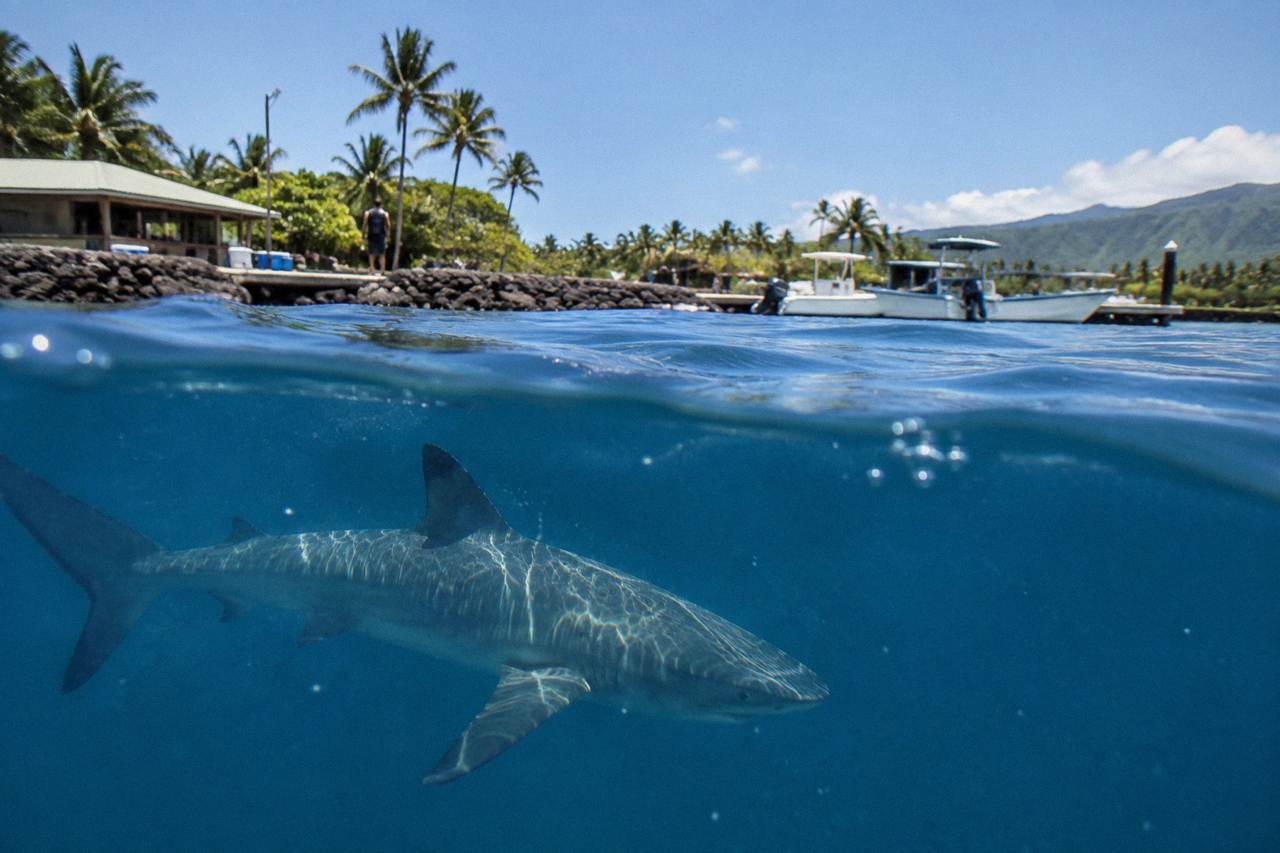
People arrive on Oahu asking about killer sharks, and the honest answer is that the phrase does the local wildlife a disservice. The sharks on the commercial tours out of Haleiwa are Galapagos sharks, sandbar sharks and, less often, tiger sharks, and none of them behave the way the movies trained visitors to expect. The state's own species list, maintained by the Division of Aquatic Resources, confirms all three as residents of Hawaiian waters, and the tour operators who hold commercial permits off the North Shore report the same trio season after season.
Meeting them in person usually means a cage tour out of Haleiwa Harbor, where the same calm species glide past without a hint of the menace the movies promised.
What Are The Most Commonly Seen Sharks On Oahu Tours?
The three species most commonly seen on Oahu shark tours are the Galapagos shark, the sandbar shark and, seasonally, the tiger shark. DLNR's official Hawaii shark species list confirms all three in Hawaiian waters, and operators running out of Haleiwa report Galapagos and sandbar sharks as the reliable daily visitors, with tiger sharks showing up more often from late summer into fall. Great whites are not part of the encounter at all.
That last sentence surprises a lot of readers. Great white sharks are rare winter visitors to Hawaiian waters at best, primarily offshore of Oahu and Maui between January and April, with only a handful of confirmed records. They are not part of the resident population and no commercial North Shore tour sells or delivers an encounter with one. The premise behind the "killer shark" search, shaped by South African and Californian cage diving footage, simply does not map onto what happens three miles off Haleiwa.
What happens instead is arguably more interesting. The boats run out past the three-nautical-mile state boundary into federal waters, to deep pelagic blue water where Galapagos and sandbar sharks naturally aggregate. Visibility at these sites is often reported at 150 feet or more, and the water beneath the cage can reach nearly 300 feet deep. Sharks ranging from about 5 to 15 feet approach the cage curiously, glide past at close range, and leave. A recent baited remote underwater video study around Oahu documented 12 elasmobranch species across 283 deployments, with sandbar sharks numerically dominating the assemblage, which matches what tour guests report seeing.
If the goal is to meet these sharks in person, three formats dominate the North Shore roster: the classic steel-cage dive, the cageless small-group swim, and the marine-scientist-led research trip.
The cage dive is the format most first-timers picture. The cageless swim is the one guests tend to describe in reviews as the more transformative experience, because there is nothing between you and the animal. The scientist-led trips sit somewhere between the two, trading pure adrenaline for interpretation. All three depart from the same general area and see the same species, so the choice is really about how much separation you want.
Which Shark Shows Up First, And What Does A Galapagos Shark Actually Look Like?
The Galapagos shark is the species most consistently reported on North Shore tours, typically in the 8-to-12-foot range, with a sturdy build, a tall first dorsal fin and a curious, investigative disposition. The IUCN lists it as Near Threatened. Reviews from the 2026 season repeatedly describe groups of seven to twenty individuals circling cages calmly, often passing within inches of the bars.
The species was named for the Galapagos Islands, but it is widespread across the tropical Pacific, and Hawaiian waters hold a healthy population. DLNR's species list carries it as one of the sharks found around the main Hawaiian Islands, and the BRUV study around Oahu found that Galapagos sharks increased in both encounter probability and abundance with greater depth, which helps explain why the tours work the deep water rather than the shallows closer to shore.
Behavior is where the "killer" framing collapses. Guest reviews from mid-2026 describe Galapagos sharks approaching the cage or swimmers, pausing, and gliding away, sometimes lingering for long stretches as if inspecting the visitors rather than the reverse. None of the documented tour-related bites in DLNR's incident log, all classified as provoked, involved predatory hunting behavior toward people, and no fatalities on commercial North Shore tours appear in DLNR's records.
The flagship cage trip for meeting Galapagos sharks is the North Shore Shark Adventures dive, rated 4.8 across 3,241 reviews, about 1.5 hours with free cancellation. For readers weighing the cageless option instead, a longer comparison lives in the cage vs cageless Oahu guide.
Why Are Sandbar Sharks The Quiet Majority Of The Encounter?
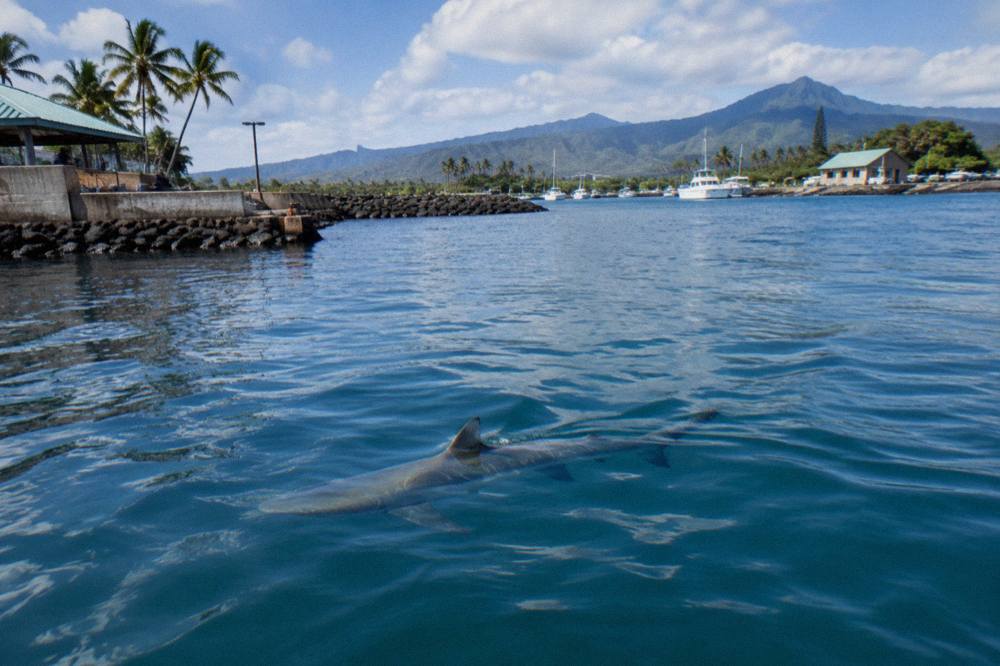
Sandbar sharks are the numerical backbone of Oahu's nearshore and offshore shark community, dominating the local assemblage in the most recent baited-video research, and they are smaller than Galapagos sharks, usually under about 6 feet on tour encounters, stocky, bronze-backed and notably relaxed around boats. The IUCN lists the species as Vulnerable.
The BRUV study is the strongest data point here. Across 283 camera deployments at depths of 10 to 90 meters around Oahu, sandbar sharks and brown stingrays dominated the counts numerically, and sandbar abundance rose with depth. The same study found most sharks encountered were immature, which matters for anyone thinking about conservation: the tours are, in effect, showing guests a nursery-adjacent population of a Vulnerable species, and several operators lean into that educational angle.
On the water, sandbar sharks read as the polite ones. They tend to hold a steadier distance than Galapagos sharks, cruise the perimeter, and are less likely to press close to the cage. Guests who expect constant close passes sometimes come away thinking the sandbars are shy, which is fair, though their sheer consistency is what makes the tours reliable. Mean shark encounter rates in the study ran 0.47 per hour, lower than in the protected Northwestern Hawaiian Islands but comparable to other tropical basins, and the aggregation sites the tours use sit where those numbers stack in everyone's favor.
For swimmers who want the small-group version of this, the cageless pick on the roster is Island View Hawaii, rated 5.0 across 1,179 reviews, which runs a cageless swim format. Guests who prefer a scientist in the water alongside them often book the One Ocean Diving swim instead, rated 4.8 across 515 reviews.
When Do Tiger Sharks Appear, And How Worried Should Anyone Be?
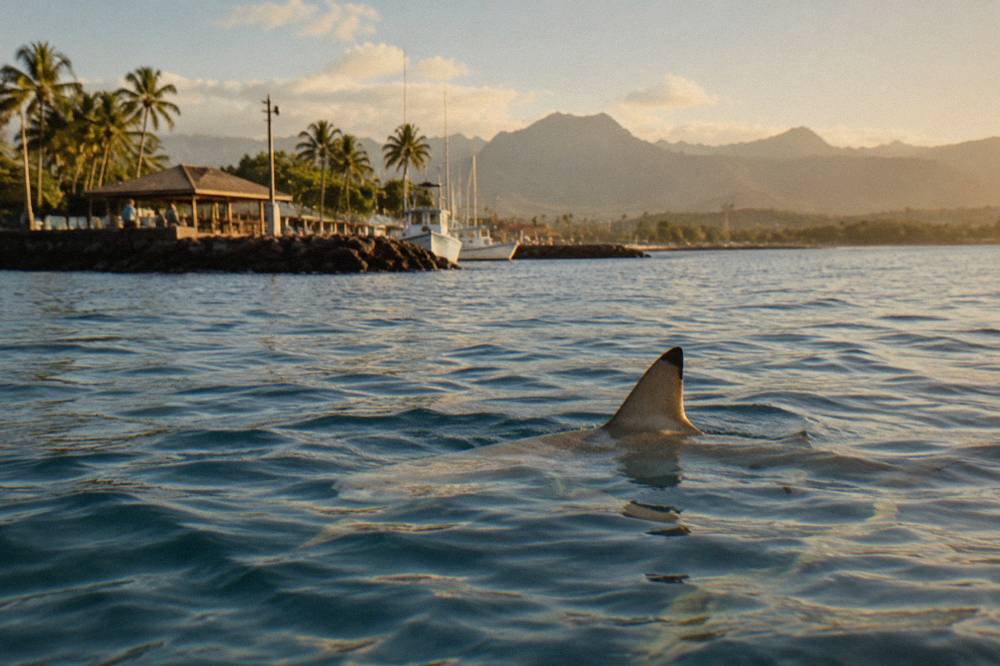
Tiger sharks are the third species on the North Shore roster, seen less often than Galapagos or sandbar sharks and with a strong seasonal pattern: a 2026 peer-reviewed analysis of long-term sighting data found peak daily sightings in October, tied to mature females arriving from the Northwestern Hawaiian Islands. The IUCN lists tiger sharks as Near Threatened, and DLNR's statewide incident data shows unprovoked bites remain rare relative to ocean use.
The October peak has a name in the diving community, Sharktober, and the science behind it is genuinely recent. The Frontiers in Marine Science analysis connected the sighting peak to parturition and partial migration of mature females, and also noted higher October bite incidents statewide, with tiger sharks accounting for at least 63 percent of those. That statewide figure covers all ocean users, swimmers and surfers included, not tour guests, and it is worth keeping the denominator in mind: Hawaii records roughly 6 to 10 confirmed shark incidents per year statewide against millions of ocean entries.
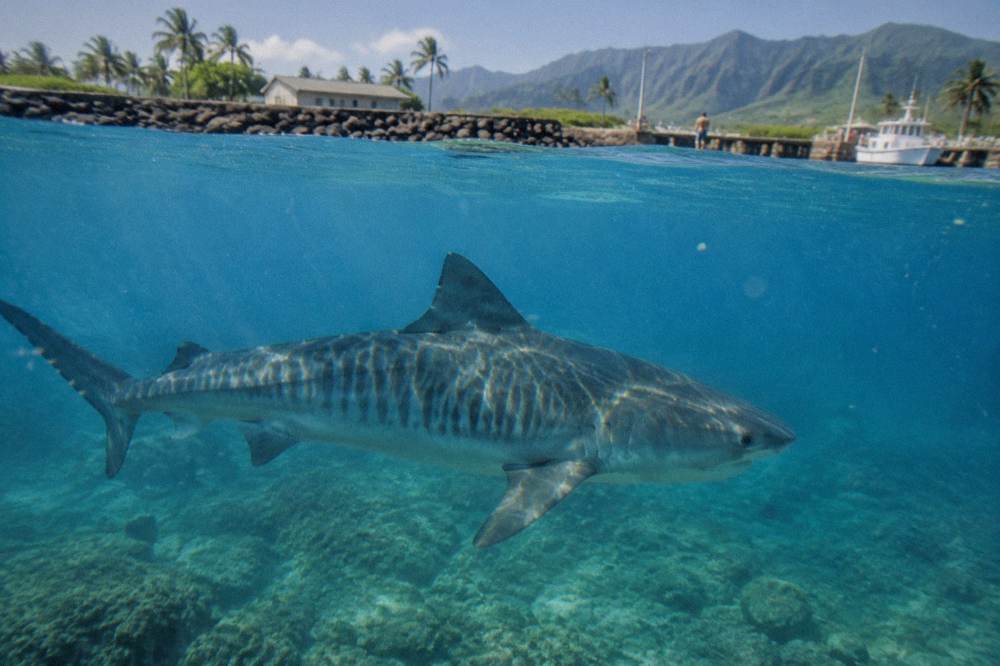
Tiger sharks are the largest of the three tour species, and the ones guests remember. Where a Galapagos shark investigates, a tiger shark tends to simply materialize, hold its line, and pass. Operators and divers report the same behavioral read: calm, unhurried, uninterested in the cage as prey. The species differs from the other two in one more way the research captured: in the BRUV study, tiger shark presence decreased with depth, the opposite of the Galapagos and sandbar pattern, which is part of why tiger encounters feel like a bonus rather than a guarantee.
| Species | Typical size on tours | IUCN status | How often seen | Behavior guests report |
|---|---|---|---|---|
| Galapagos shark | 8 to 12 feet | Near Threatened | Most days, often in groups | Curious, close passes to the cage |
| Sandbar shark | Up to about 6 feet | Vulnerable | Most days, the reliable core | Steady, keeps distance, calm |
| Tiger shark | Larger than both | Near Threatened | Seasonal, peak in October | Unhurried passes, occasional |
Why The Law, Not Luck, Decides Where These Encounters Happen
Commercial shark tours off Haleiwa operate roughly three nautical miles offshore in federal waters because Hawaii law, HRS §188-40.6, has prohibited shark feeding in state marine waters since 2002, with narrow cultural and incidental exceptions. The statute's own text defines commercial activity to include tours and charters, so operators run past the state boundary where the aggregation sites sit.
The state legislature's page carries the statute verbatim: it is unlawful for any person to conduct any activity related to the feeding of sharks in state marine waters, and the definition of commercial activity explicitly covers guide services, charters, tours and transportation. A separate 2022 law, HRS §188-40.8, bans the intentional capture, entanglement or killing of sharks in state waters altogether. No 2025 or 2026 bill targeting commercial shark tours was found in the legislature's records, so the framework holding these trips together has been stable for years.
The practical effect for a reader scanning tour pages is simple. Every permitted operator works the same deep-water sites outside the state line, holds a commercial use permit through the Division of Boating and Ocean Recreation, and shows guests the same three species. DLNR indicated roughly three commercial permits specifically for shark tours operating out of Haleiwa in recent reporting, and an unpermitted North Shore operation drew $10,000 in administrative fines in 2026, which tells you the state takes the licensing seriously. Booking a permitted operator is not just a safety choice, it is the legal architecture that keeps the whole experience running.
The simplest way to stay on the right side of that system is to book a permitted North Shore shark tour ahead of your visit.
Which Tour Format Gives The Best Look At Each Species?
The steel-cage dive maximizes time with Galapagos and sandbar sharks at close range behind bars, the cageless swim puts open water between you and the same animals, and the research-led trips add the interpretation that makes tiger shark seasonality and depth patterns legible. All three formats see the same species from the same harbor area, so format, not species, is the real decision.
The cage is the right call for anyone who wants the closest possible view without sharing the water. Reviews describe Galapagos sharks passing inches from the bars, which is a proximity the cageless format cannot engineer on demand. The cageless swim trades that guarantee for the visceral fact of nothing between you and the shark, and guests on those trips report the sandbars' calm perimeter behavior most often, since the smaller species holds its distance in open water too.
The scientist-led format deserves a specific mention for readers who arrived here through the "killer shark" question. A marine biologist in the water can name the individual behaviors, explain why the sandbars dominate the counts, and put the October tiger peak into the population context that a standard briefing skips. For travelers still deciding whether the whole thing is worth the drive, the is shark diving in Oahu worth it post works through that question directly, and the North Shore species guide covers the sighting patterns in more depth.
One practical note on timing: the summer months from May through September bring calmer seas, clearer water and steadier schedules to the North Shore, while winter swells from November through April can bump up cancellations. October sits at an interesting intersection, with the tiger shark sighting peak overlapping the tail of the calm season, which is why some returning guests book that window deliberately (see Shark Sighting Odds).
Common Questions About Sharks On Oahu Tours
What Are the Most Commonly Seen Sharks on Oahu Tours?
Galapagos sharks and sandbar sharks are the species seen most consistently, often on the same trip, with tiger sharks appearing seasonally and less often, peaking around October. DLNR's official species list confirms all three as present in Hawaiian waters, and tour reviews from 2026 describe groups of Galapagos sharks alongside steady sandbar shark activity.
Are there great white sharks on Oahu shark tours?
No. Great whites are not part of Hawaii's resident shark population and are only rare winter visitors to Hawaiian waters overall, primarily offshore of Oahu and Maui between January and April, with very few confirmed records. No commercial North Shore tour offers or delivers great white encounters.
Are Galapagos sharks dangerous to cage divers?
DLNR's incident log classifies every documented tour-related bite off Haleiwa as provoked, and no fatalities on commercial North Shore tours appear in DLNR's records. Guest reviews consistently describe Galapagos sharks as curious and calm around cages, investigating without charging. The species is listed as Near Threatened by the IUCN, not as a threat to people.
When is tiger shark season on Oahu?
A 2026 peer-reviewed analysis of long-term sighting data at North Shore ecotourism sites found peak daily tiger shark sightings in October, linked to parturition and partial migration of mature females from the Northwestern Hawaiian Islands. Tigers are seen outside that window too, just less predictably, and the same study noted tiger presence decreases with depth.
Why do Oahu shark tours go so far offshore?
Hawaii law has banned shark feeding in state marine waters, generally the first three nautical miles from shore, since 2002, and the statute defines commercial tours as covered activity. Operators therefore run past the state boundary into federal waters, where the deep pelagic aggregation sites sit, roughly three to four miles off Haleiwa Harbor.
Which Oahu shark tour is best for first-timers?
The steel-cage dive is the most common first choice, and the flagship option on this site's roster is North Shore Shark Adventures, rated 4.8 across 3,241 reviews. Travelers who want open water instead of a cage tend toward the cageless small-group swim, rated 5.0 across 1,179 reviews. Prices for both are on the live listings.
The short version for anyone who came here through a search about killer sharks: the animals off Haleiwa are real, well-documented, and nothing like the premise. Galapagos sharks investigate, sandbar sharks hold the perimeter, and tiger sharks pass through on a schedule marine science now understands better than ever (see Sharks Cove vs Hanauma Bay). The team at Shark Cage Diving Honolulu keeps the species and seasonality breakdowns current as the research and the tour rosters evolve.