Has There Been A Fatal Shark Attack On An Oahu Shark Tour?
The straight answer on fatal shark attacks on Oahu shark tours, what Hawaii's official incident log records, and how the North Shore tours manage risk offshore.
 By Shark Cage Diving Honolulu Editorial Desk, Honolulu shark cage diving charter research and booking desk
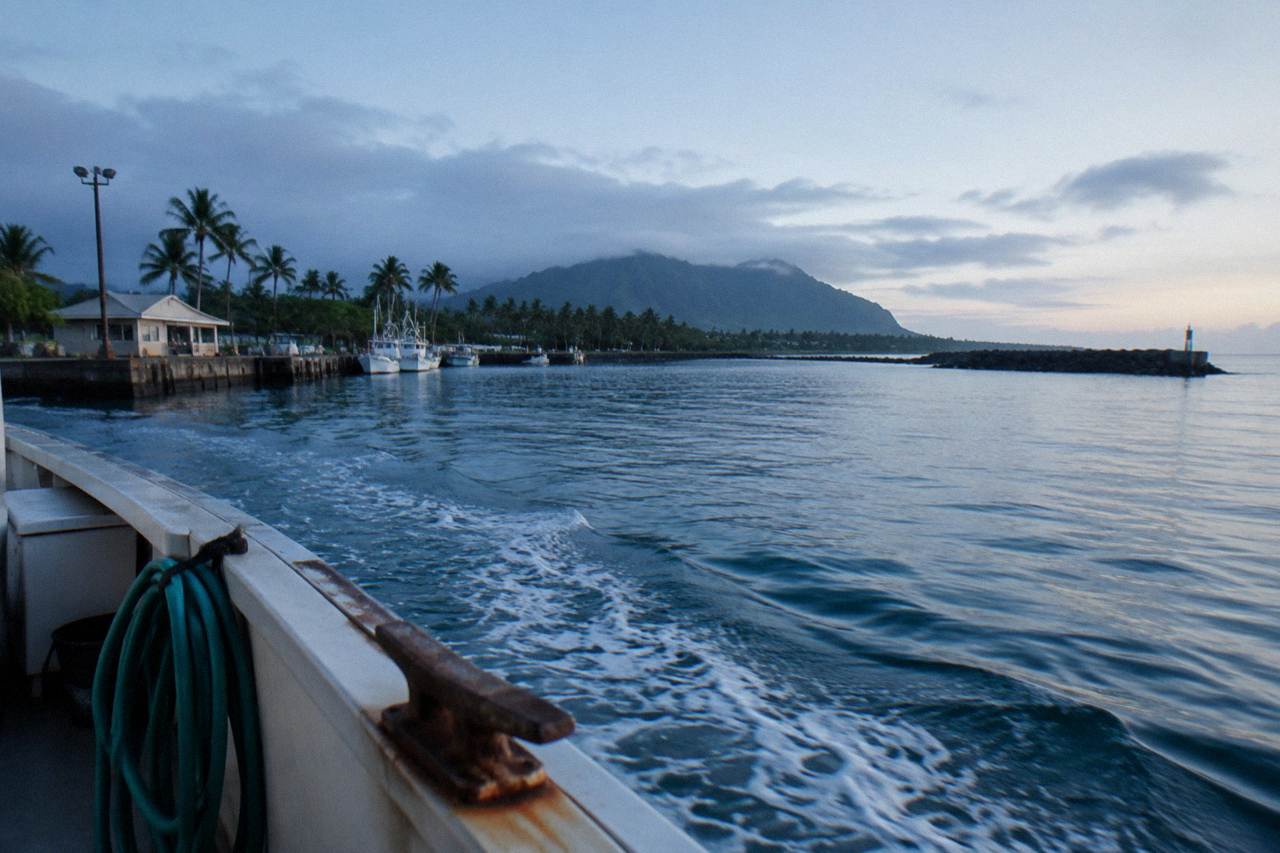
Has There Been A Fatal Shark Attack On An Oahu Shark Tour?
No fatalities on Oahu North Shore commercial shark tours have been found in DLNR's records. The state's official shark incident log, maintained by the Division of Aquatic Resources, documents bites and nearshore incidents across Hawaii going back decades, and no death attributable to a commercial cage or cageless tour operating out of Haleiwa appears in it. That is the plain, source-backed answer.
The question deserves that and rarely gets it. Next: free things to do on the North Shore. Search for shark attacks in Hawaii and you will find a swirl of headlines about surfers, swimmers, and murky nearshore encounters, mixed in with dramatic stock footage of great whites that have nothing to do with these islands. Separating the tour record from the general ocean record takes a little work, and this article does that work using the state's own tracking rather than secondhand summaries. The distinction matters for anyone standing on the dock at Haleiwa Harbor at six in the morning, wondering whether the trip they are about to take belongs in the same category as the headlines.
Start with what the log is. The DLNR shark incidents list is the authoritative statewide record of confirmed shark incidents in Hawaii. It distinguishes provoked cases from unprovoked ones, excludes doubtful reports and boat strikes, and it is the document marine agencies and researchers treat as the baseline. When this site says no tour fatalities have been found, that log is the source. It is updated on a rolling basis by the Division of Aquatic Resources, and it is public, which means anyone can read the same entries this article's research drew on.
It helps to see the actual landscape of options before going deeper into the record. The three tours below are the ones this site tracks most closely for the North Shore: the flagship cage dive, a cageless small-group swim, and a Slip 19 departure that offers a different boarding setup.
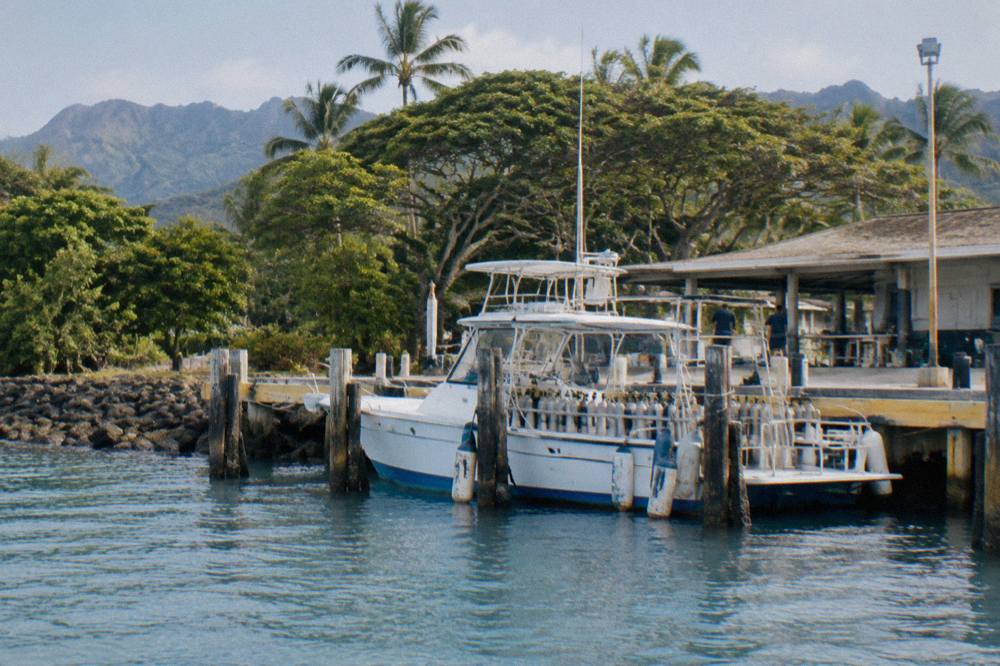
The flagship of the group is the North Shore cage dive, rated 4.8 across 3,241 reviews, which puts more guest feedback behind it than any other shark tour on Oahu. That review pool matters for a safety question as much as a quality one: thousands of guests have gone through the experience and left written accounts, and the recurring themes in those accounts are awe, nerves before the drop, and calm professionalism from the crew. If the safety question is what brought you here, the is shark cage diving safe guide breaks down the cage itself, the crew protocols, and the honest caveats in more detail than this article can.
What Does Hawaii's Official Shark Incident Log Actually Record?
The log tracks confirmed incidents statewide, classifies each as provoked or unprovoked, and covers every kind of ocean use: surfing, swimming, spearfishing, diving, and commercial tours. It is not a tour-specific document. Tour-related entries appear inside it alongside everything else, which is exactly why it is trustworthy: nobody curates it to make any operator look good.
An unprovoked incident, in the log's terms, is one where the shark initiates contact with a person who was simply present in the water. A provoked incident is one where the circumstances involved attracting, handling, or otherwise interacting with the animal in a way that changed its behavior. The distinction matters here because commercial shark swims, by design, place people in the water near sharks, and the classification framework treats that context differently from a surfer bitten at dawn. A tour guest who enters the water at a known aggregation site has entered a context the state's own taxonomy recognizes as different from ordinary recreational use.
What the log does not contain, based on every review of it this site's research has made, is a fatality tied to a permitted commercial cage or cageless shark tour operating off Oahu's North Shore. That sentence is deliberately narrow. It does not claim shark tours are risk-free, and it does not erase the fact that bites have occurred in the tour context. It says only what the record supports: no deaths. Writing it any broader would be marketing, and writing it any narrower would be dishonest alarm.
For readers who want the fuller risk picture, including the honest discussion of cage integrity and what happens when a shark behaves unexpectedly, the how risky is shark cage diving article covers it. The short version: risk on these tours is managed, not absent, and the record reflects management working so far. The long version involves reading the incident classifications, understanding what the cage does and does not physically prevent, and accepting that any honest account of open-water wildlife includes the word "rare" rather than "never."
How Common Are Shark Incidents In Hawaii Overall?
Statewide, Hawaii logs roughly six to ten confirmed shark incidents per year, the large majority unprovoked and nearshore, involving surfers, swimmers, and spearfishers rather than tour guests. Oahu sees a high volume of ocean use and a share of incidents, but serious outcomes remain rare relative to how many people enter the water daily.
The numbers stay low year over year, and the pattern inside them is consistent: most incidents happen close to shore, in the places where people and coastal sharks overlap. Reef drop-offs, river mouths, turbid water after rain, and dawn and dusk activity windows account for a disproportionate share. The deep blue water three miles off Haleiwa, where the tours operate, is a different habitat with a different shark community and almost no recreational swimmers. When the state's incident summaries describe where Hawaii's bites cluster, they describe coastlines and bays, not the pelagic zone.
| Context | Typical location | Who is involved | What the DLNR log shows |
|---|---|---|---|
| Recreational ocean use | Nearshore surf, swim, and dive spots | Surfers, swimmers, spearfishers | The bulk of confirmed incidents each year |
| Commercial shark tours | Roughly three miles offshore, federal waters | Cage and cageless tour guests | Entries exist, classified by circumstance; no fatalities found |
| Pelagic tour habitat | Deep open water past the state line | Tour guests and crew only | A distinct habitat from nearshore incident zones |
The takeaway is not that the ocean is dangerous or that it is safe. It is that the incident record is dominated by contexts that look nothing like a boat trip to a pelagic aggregation site. Anyone comparing a North Shore cage dive against a sunrise surf session is comparing two very different exposures. Maui has historically accounted for a large share of Hawaii's most serious cases, while Oahu records more overall ocean use and, in broader records, has seen no shark-related fatality since 1994 (see Shark Diving in Maui). Those statewide patterns sit behind the tour-specific answer the way weather sits behind a forecast: they are the environment the tours operate within, not the tours themselves.
Why Do The Tours Run Three Miles Offshore?
Hawaii law bans shark feeding in state marine waters, the zone from the shoreline out to three nautical miles, so commercial shark tours cannot operate their attraction-based model inside that line. They run past it into federal waters, where the state ban does not apply, and that legal boundary is the reason every Haleiwa shark boat travels roughly three miles out before stopping.
The statute is HRS §188-40.6, enacted in 2002. It makes it unlawful to conduct any activity related to feeding sharks in state marine waters, with narrow exceptions for non-commercial traditional Hawaiian cultural or religious practices and for incidental feeding during lawful fishing. Commercial activity is defined broadly in the statute, covering charters, tours, guide services, and transportation to the location, so there is no loophole for an operator to run a feeding-based tour inside state waters for pay. The definition closes the door on the workaround before anyone can try it.
The result is a de facto zoning of the industry. Inside three miles, no commercial shark attraction. Outside it, in federal waters, operators work established pelagic sites where Galapagos and sandbar sharks naturally aggregate, historically around areas of past crab-boat activity. The sharks that show up are wild animals arriving on their own patterns, not a resident population maintained by daily handouts inside a bay. Guests sometimes ask on the ride out why the boat keeps going when sharks are surely closer to shore, and the legal answer and the ecological answer are the same answer. Everything else covered here is indexed on Shark Cage Diving Honolulu.
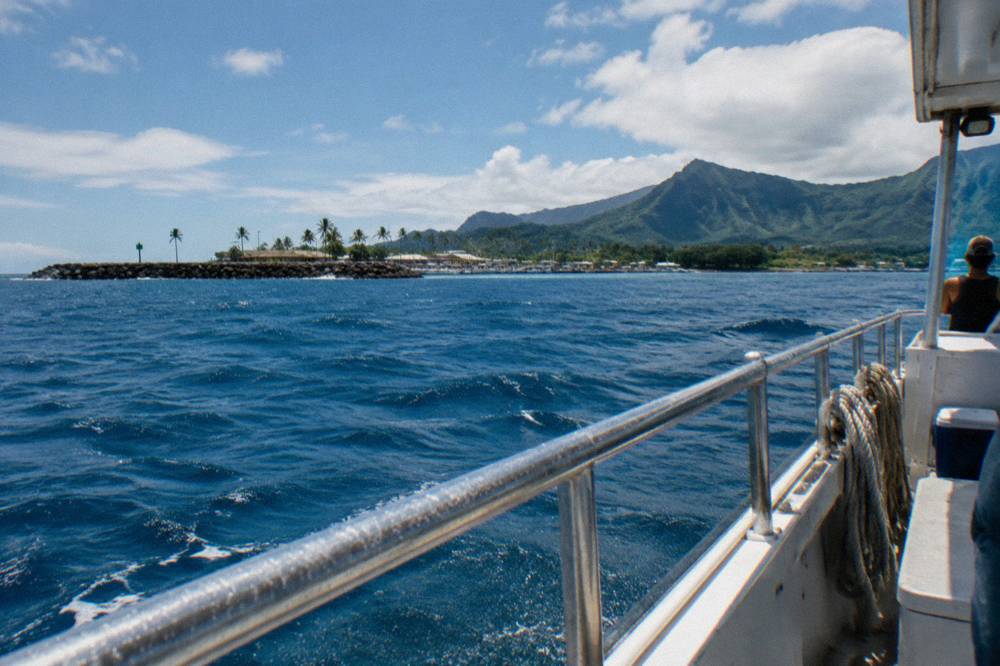
The cageless option below also meets at Haleiwa Boat Harbor, so the North Shore drive from Waikiki is the same either way. The Waikiki to Haleiwa guide compares the transport options, driving, bus, and rideshare, and what the drive from Waikiki to the harbor typically takes; no operator on this roster includes hotel pickup.
The regulatory picture also explains something the fatal-attack question often misses. A tour that cannot legally feed sharks inside state waters is a tour built around viewing animals that choose to be there. That shapes everything from where the boat stops to how the crew reads shark behavior on a given morning. It also means the encounter site is far from swimmers, lifeguards, and reef users, which is part of why the tour context and the nearshore incident context barely overlap in the state's data.
What Species Actually Swim Around The North Shore Tours?
Galapagos sharks and sandbar sharks are the two species North Shore tours most consistently report, with tiger sharks seen less often and mainly in late summer and fall. No great white sharks are part of the commercial North Shore encounter, and any article, video, or ad implying otherwise is describing a different ocean entirely.
Great whites are not part of Hawaii's resident shark population. They are rare winter visitors to Hawaiian waters at most, with a handful of confirmed records, and none of the Haleiwa operators show them. The dramatic footage that dominates search results for shark cage diving comes from South Africa, Australia, and California, where pinniped-rich coasts support white shark populations (see Cage Diving in Hawaii). Oahu's tours run in a different ecological context, and the correction matters because the fatal-attack question is usually asked with a white shark mental image attached. The species that actually appear off Haleiwa are smaller requiem sharks with different behavior patterns around people.
| Species | Scientific name | IUCN status | How often tours report it |
|---|---|---|---|
| Galapagos shark | Carcharhinus galapagensis | Near Threatened | Most consistent, year-round |
| Sandbar shark | Carcharhinus plumbeus | Vulnerable | Most consistent, year-round |
| Tiger shark | Galeocerdo cuvier | Near Threatened | Occasional, mainly late summer and fall |
The DLNR species list confirms all three as Hawaiian waters residents. Guests on the tours typically see Galapagos sharks in the eight-to-twelve-foot range, sometimes in groups, approaching the cage or swimmers with calm, investigative behavior rather than aggression. The what sharks will you see guide covers the sighting patterns season by season for readers planning around a specific species, including the late-summer window when tiger shark odds tick upward.
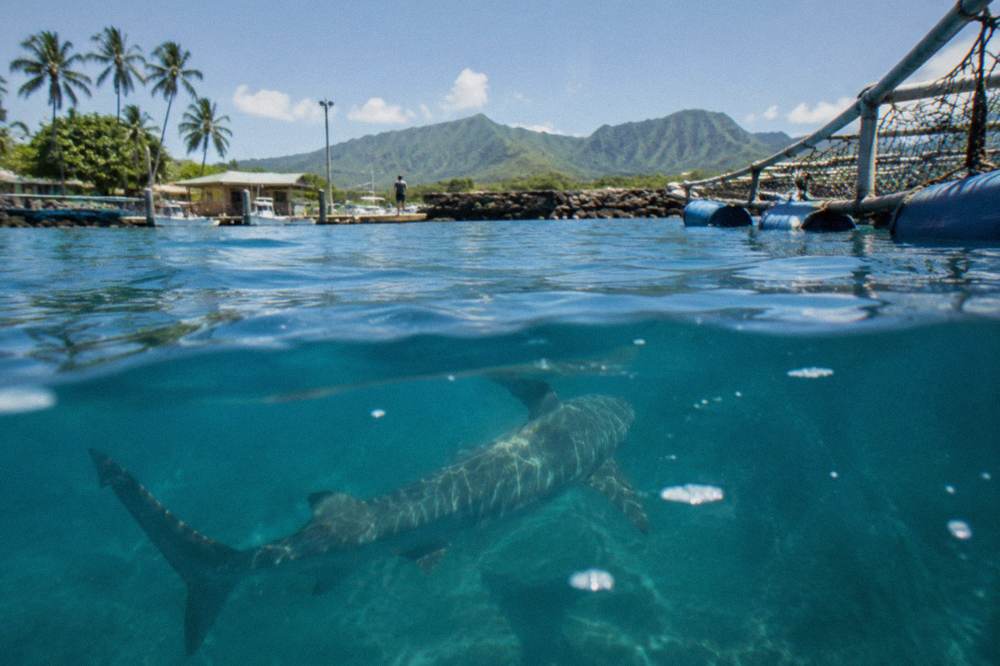
One operator below departs from Slip 19 with a smaller-boat setup, which suits readers who like the idea of a lower-headcount trip on the same stretch of pelagic water.
Behaviorally, these are smaller requiem sharks, typically under fifteen feet, exhibiting curiosity around cages and swimmers without the predatory strike patterns associated with white sharks elsewhere. Operators fold in education on Hawaiian cultural significance, including the shark god Kamohoaliʻi, and on conservation, which is a fair part of what the better-reviewed crews spend the boat ride discussing. A peer-reviewed baited-video study around Oahu documented twelve elasmobranch species across 283 deployments, with sandbar sharks numerically dominant and both sandbars and Galapagos sharks increasingly abundant at greater depth, which lines up neatly with why the tours work deep water sites rather than the shallows.
How Do Operators Manage Risk On The Water?
Risk management on these tours is layered: permitted operations under DLNR commercial use rules, standardized commercial passenger vessel regulation, crew protocols for reading shark behavior, and equipment design, whether a steel cage or a structured cageless swim format. No layer removes risk, and the honest framing is that a decades-long record without a tour fatality reflects systems working, not an absence of danger.
Permits come first. DLNR's Division of Boating and Ocean Recreation issues commercial use permits for ocean recreation activities, and reporting around 2025 indicated roughly three commercial permits specifically for shark tours operating out of Haleiwa. Operators must also meet vessel registration, insurance, and financial responsibility requirements, and unauthorized commercial activity draws real fines: a 2026 case involving unpermitted North Shore operations resulted in $10,000 in administrative penalties. The permitting layer is what keeps the industry small, inspected, and traceable, which is a quiet but real part of the safety story.
Then comes behavior on the water. Crews on the established operations brief guests before anyone gets wet, watch how the sharks arrive and behave throughout the encounter, and end sessions when animal behavior or conditions warrant it. The cageless programs that run safely over long periods do so by keeping groups small, keeping guests at the surface, and maintaining the kind of distance and positioning that does not crowd or corner an animal. The cage versus cageless comparison lays out the trade-offs between the two formats honestly, because they are not equivalent experiences and they do not carry identical risk profiles.
Seeing these protocols in practice is the surest way to judge an operator, and the North Shore Shark Adventures cage dive is one of the long-running programs built around them.
Finally, the guest's own choices matter. Disclosing medical conditions, following crew instructions, staying within the format you booked, and being realistic about comfort in open water all reduce the chance of a bad morning. The record this article opened with is a record built by permitted operators and briefed guests together, one trip at a time, across more than two decades of commercial operation out of Haleiwa Harbor.
If the bottom line is what you came for, here it is again: no fatalities on Oahu North Shore commercial shark tours have been found in DLNR's records, and the three tours below are the ones this site would point anyone toward for a first encounter.
Common Questions About Fatal Shark Attacks In Hawaii
Has There Been a Fatal Shark Attack on an Oahu Shark Tour?
No fatalities on Oahu North Shore commercial shark tours have been found in DLNR's records. The state's official shark incident log, which tracks confirmed incidents statewide, contains no death attributable to a permitted commercial cage or cageless shark tour operating out of Haleiwa.
How many shark incidents does Hawaii record each year?
Roughly six to ten confirmed incidents per year statewide, consistent with historical averages. The large majority involve nearshore recreational ocean use such as surfing and swimming, not commercial tour guests.
Do shark bites ever happen on Hawaii shark tours?
Yes, bites have occurred in the tour context, and the state log classifies them by circumstance. None has been fatal. The record supports calling these tours managed risk, not zero risk, and honest operators describe them the same way.
Are great white sharks involved in Oahu shark tours?
No. Great whites are not part of Hawaii's resident shark population and are not what North Shore operators show guests. The tours see Galapagos sharks, sandbar sharks, and occasionally tiger sharks.
Why do the shark tours go so far offshore?
Hawaii law bans shark feeding in state marine waters, the zone out to three nautical miles. Commercial tours operate past that line in federal waters, where the state ban does not apply, at pelagic sites where sharks naturally aggregate.