Can You Shark Cage Dive In Maui?
Maui has no commercial shark cage dive. Here is why Hawaii's cage diving is concentrated on Oahu's North Shore, and how to build the trip from Maui.
 By Shark Cage Diving Honolulu Editorial Desk, Honolulu shark cage diving charter research and booking desk
Can You Shark Cage Dive In Maui?
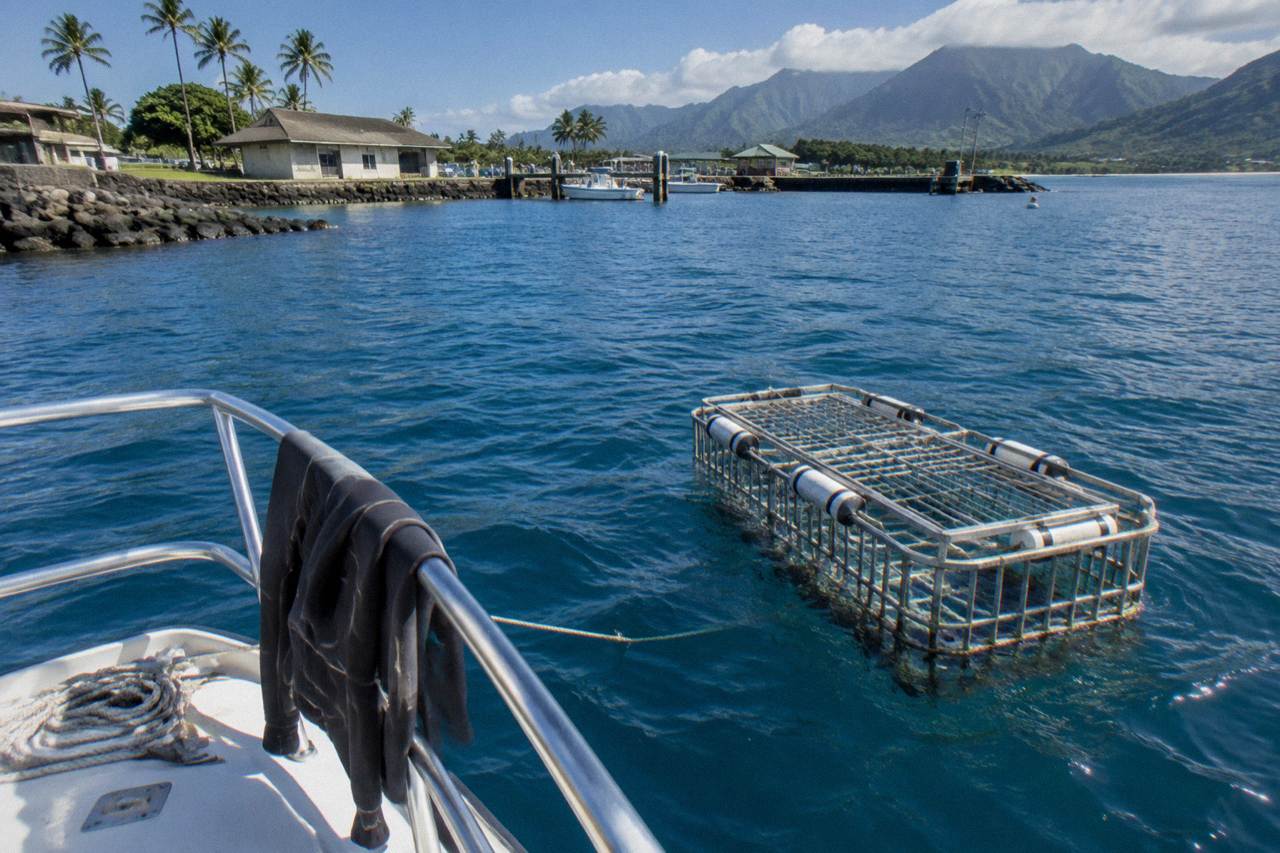
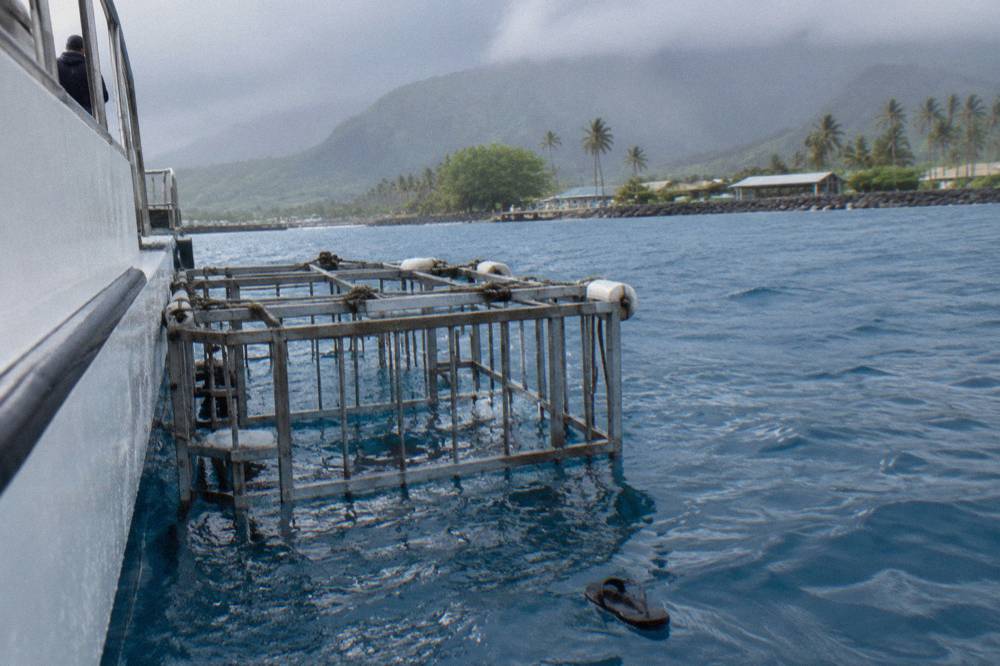
No. There is no commercial shark cage dive operating from Maui. Every licensed cage operation in Hawaii runs out of Haleiwa Boat Harbor on Oahu's North Shore, roughly 32 miles from Waikiki, and holds its shark encounters about three miles offshore in federal waters. DLNR reporting puts the permitted shark tours departing Haleiwa at approximately three operators. If you want a cage, you fly to Oahu.
That is the short, honest answer, and it surprises a lot of travelers who assumed each island runs its own shark program. The search results for Maui cage diving are full of pages that quietly redirect you to Oahu without saying so, which wastes your planning time. This page says it plainly: the cage is on Oahu, and the rest of this article explains why that is, what you would actually see there, and how to build the trip from Maui in a single day if you are already committed to the Valley Isle.
The reason is regulatory and geographic at the same time. Hawaii banned shark feeding in state marine waters in 2002 under HRS §188-40.6, which covers the water from shore out to three nautical miles. Commercial operators therefore work outside that line, and the deep pelagic water where Galapagos and sandbar sharks naturally aggregate happens to sit a short run off Haleiwa. Maui's nearshore topography simply does not offer the same combination of a sheltered harbor, quick deep-water access, and an established aggregation site, so the permitted industry clustered on Oahu's North Shore and stayed there.
It is worth being clear about what "no cage dive in Maui" does and does not mean. It does not mean Maui's waters are empty of sharks; Galapagos, sandbar, and tiger sharks all move through Hawaiian waters statewide, and DLNR's incident tracking confirms sharks are present around every major island. It means no operator holds a commercial permit to run a cage encounter from a Maui harbor, and none has in recent years. So the choice in front of a Maui-based traveler is not between a Maui cage and an Oahu cage. It is between skipping the experience entirely and making the short hop to where the industry actually operates.
For travelers who choose the hop, the North Shore shark cage tour lays out how the operation runs, from the boat departure to time in the water beside the same species that pass through Maui's waters.
If you are flexible on islands, the three tours below are the ones worth comparing first: the flagship cage dive, a cage-free alternative, and a smaller-operator option.
Why Is The Cage On Oahu And Not Maui?
Because state law pushes shark tours past the three-mile line into federal waters, and Haleiwa is where the deep-water shark aggregation site sits closest to a harbor. DLNR issues commercial use permits for these operations, and reporting around 2025 counted roughly three commercial permits specifically for shark tours operating out of Haleiwa. Maui has neither the permitted operators nor the site.
The state feeding ban is the piece most first-page explanations skip. Because a commercial tour cannot legally feed or chum for sharks inside state waters, an operator needs a boat fast enough and a harbor close enough to reach federal water efficiently, then hold a safe encounter in deep blue pelagic conditions. Haleiwa Boat Harbor sits at 66-105 Haleiwa Road on Oahu's North Shore, with public restrooms, free parking, and boat ramps, which makes it a practical base. From there the run out is about three miles to water that operators describe as 150-plus feet of visibility over depths approaching 300 feet.
The species science backs up the location choice too. A recent baited remote underwater video study around Oahu documented 12 elasmobranch species, with sandbar sharks dominating the counts numerically and both sandbar and Galapagos sharks becoming more abundant with depth. That deep-water abundance is exactly what the Haleiwa operators position their cages beside. The same study found shark body size increased with depth and most sharks encountered were immature, which matches what tour guests report: curious animals in the five-to-fifteen-foot range, not large predatory adults.
There is also a cultural layer that explains why the industry stayed small and concentrated. Hawaii's relationship with sharks is not the horror-movie framing mainland visitors arrive with; sharks are ʻaumakua, ancestral guardians, in many Hawaiian families, and operators lean into that education on the boat. A related question travelers ask is whether one island beats another for sharks generally, and the answer leans Oahu for the same reasons; see our longer piece on which Hawaiian island is best for shark diving for the comparison.
If the Maui leg of your trip is fixed and you are weighing whether the interisland hop is worth it, the flagship option is the one most visitors end up booking.
What Sharks Would You Actually See From The Cage?
Galapagos sharks and sandbar sharks, reliably, typically in the five-to-fifteen-foot range, with tiger sharks as a seasonal possibility rather than a promise. Reviews from 2026 describe groups of Galapagos sharks gliding calmly within inches of the cage, curious but not aggressive. No great white sharks are part of the commercial North Shore encounter, and none of these operators advertise one.
This matters for Maui planners because the mental image many people carry, a great white ramming a cage off South Africa or California, is not what Hawaii offers. Hawaii's resident cage species are smaller requiem sharks with an investigative rather than predatory posture around people. The DLNR species list confirms Galapagos sharks, sandbar sharks, and tiger sharks in Hawaiian waters, with the first two being what North Shore tours most consistently report. Tiger sightings skew toward late summer and fall, though month-level tiger seasonality is operator-reported rather than a DLNR-confirmed fact, so treat it as a bonus, not a booking reason.
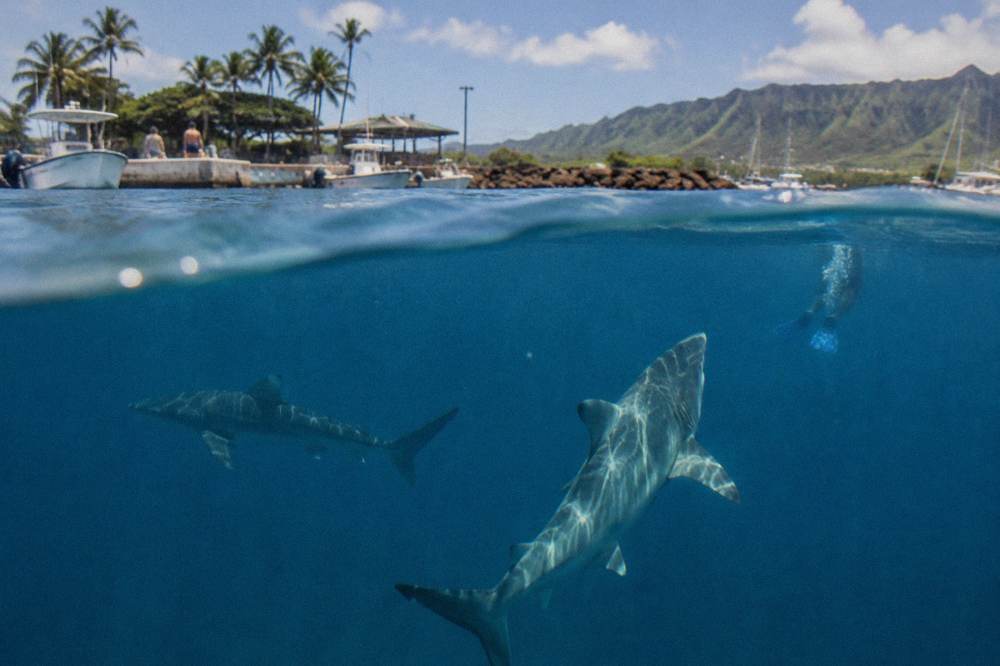
The encounter style is also gentler than the imagery suggests. Sharks approach the cage or the swimmers curiously, and 2026 guest accounts describe seven to twenty Galapagos sharks at a time behaving calmly around the boat. Operators fold in education on Hawaiian cultural significance, including the shark god Kamohoaliʻi, and on conservation, so the trip reads closer to a guided wildlife encounter than a stunt. For a fuller species breakdown, see our guide to what sharks you will see off Oahu's North Shore.
One more expectation to set before you spend money on flights: the sharks you meet are wild animals at an aggregation site, not performers at an attraction. Sightings are extremely consistent for Galapagos and sandbar sharks, which is why one operator in the cageless category feels confident enough to attach a shark-sighting guarantee to its research trip, but behavior varies day to day. Some days the animals orbit the cage at close range for the whole session; other days they hold a wider circle and the crew works the site longer. Neither outcome is a bad trip, but knowing the range in advance keeps the experience honest.
Can You Do The Oahu Cage Dive As A Day Trip From Maui?
Yes, comfortably. Interisland flights between Maui and Honolulu run frequently and short, the drive from Honolulu to Haleiwa takes roughly 45 to 75 minutes depending on traffic, and morning tour departures pair well with an early flight over. Book the tour first, then the flights around it, because the departure time drives the whole schedule.
The logistics are the part Maui travelers underestimate. From Waikiki or Honolulu, the run to Haleiwa Boat Harbor is about 32 to 35 miles, typically 45 minutes with no traffic and closer to an hour and ten in normal conditions, via H-1 west to H-2 north and then Kamehameha Highway. Rush hours, big-surf days, and summer weekends add time, and the two-lane Wahiawa stretch is a known bottleneck, so an early start is the standard advice. Rental cars sampled in 2026 ran roughly $42 to $64 per day before taxes and fees, while one-way rideshares often estimate $130 to $160, which makes a rental the better arithmetic for a day trip. More of these guides are collected on Shark Cage Diving Honolulu.
No North Shore operator removes the drive from the interisland day trip: Hawaii Shark Encounters, rated 4.8 across 1,556 reviews, and Haleiwa Shark Tours, rated 4.9 across 313 reviews, both meet travelers at Haleiwa Boat Harbor, so a rental car or rideshare from the airport is part of the plan either way. That matters more than it sounds when your margin for error is a single morning: a missed turn on Kamehameha Highway is recoverable on a leisurely North Shore day, but not when a boat leaves without you.
One scheduling note worth planning around: winter swells from November through April make the offshore run bumpier and push cancellation rates up, while May through September brings calmer seas, clearer water, and steadier schedules. If your Maui dates are flexible, aim the cage day at the calmer side of the calendar, and check our guide to the best time of year for shark diving on Oahu before you lock flights. Build a buffer day into the itinerary if you can, because a weather cancellation on your only free morning means the whole interisland plan collapses, while a cancellation on day one of three is just a rebooking.
What About Cage-Free Shark Swimming Instead?
If the cage itself was never the point, cage-free shark swims are the other format, and they also run from Oahu's North Shore rather than Maui. These are small-group surface swims with sharks, no cage between you and the animals, guided by crew who read shark behavior in real time. The flagship cageless option holds a 5.0 rating across 1,179 reviews.
The cage-free choice polarizes people, and honestly so. On one side, the DLNR incident log classifies every documented bite tied to these tours as provoked, and no fatalities on commercial North Shore shark tours appear in DLNR's records, so the aggregate safety picture is better than the headlines imply. On the other, a provoked-incident classification is not the same as a zero-risk guarantee, and we unpack that distinction fully in our piece on whether cage-free shark diving in Oahu is safe. The decision deserves the full argument, not a reassurance line.
Among the cageless operators, One Ocean Diving's swim program stands out for its framing: marine-scientist-guided trips, rated 4.8 across 515 reviews, built around research and education rather than adrenaline. Its sister research trip carries a 4.9 rating across 587 reviews with a shark-sighting guarantee. The smaller Go Adventure Hawaii option, rated 4.8 across 153 reviews, includes a wetsuit top, which is a practical detail worth noting for anyone sensitive to cooler water.
For readers comparing the two formats side by side, steel cage versus open water, our cage versus cageless comparison for Oahu walks through who each format genuinely suits. The short version: nervous swimmers and families with kids tend to prefer the cage, confident snorkelers who want the unobstructed encounter tend to prefer cageless. Neither format is available from Maui, so the island decision comes first and the format decision second.
How Much Does A Shark Cage Dive Cost?
Every tour price on this site's roster is listed on the operator's live listing rather than quoted here, and the honest comparison is therefore by rating, review depth, and what is included. The flagship North Shore Shark Adventures cage dive, rated 4.8 across 3,241 reviews, runs about 1.5 hours; the cageless flagship at 5.0 across 1,179 reviews includes a small-group format. Check each listing for the current fare before booking flights.
Here is how the main Oahu options stack up on the factors you can verify, with prices left where they belong, on the listings:
| Tour | Format | Rating and reviews | Notable inclusions |
|---|---|---|---|
| North Shore Shark Adventures | Steel cage dive | 4.8 from 3,241 reviews | Largest review pool |
| Hawaii Shark Encounters | Cage dive | 4.8 from 1,556 reviews | Self-drive or rideshare |
| Haleiwa Shark Tours | Cage dive | 4.9 from 313 reviews | Smaller groups, flexible schedule |
| Island View Hawaii | Cage-free swim | 5.0 from 1,179 reviews | Small-group format |
| One Ocean Diving (swim) | Cage-free swim | 4.8 from 515 reviews | Marine-scientist guides |
| One Ocean Diving (research) | Cage-free swim | 4.9 from 587 reviews | Sharks guaranteed |
| Ocean Outfitters Hawaii | Cage-free swim | 4.8 from 271 reviews | Slip 19 departure |
Review depth is worth reading carefully when you compare, because a 5.0 and a 4.8 can mean very different things depending on the pool behind them. A 5.0 across 1,179 reviews is a remarkably consistent verdict from a large sample; a 4.9 across 313 reviews is strong but from a smaller base; and a rating drawn from a few dozen reviews tells you less, whatever the number says. This is exactly why the table prints the count beside every rating rather than letting a bare number do the talking. For a fuller breakdown of what a shark dive costs across the islands, including the Big Island's Kona scene, see our guide to shark cage diving prices in Hawaii. The Kona operations are a separate market from the Haleiwa cage fleet, and travelers weighing Maui against Kona should read what it costs to go shark diving in Kona before assuming Oahu is the only alternative.
Readers who want to weigh the Haleiwa option against the Kona market can check the North Shore Shark Adventures tour page, where the rating sits next to the review count that supports it.
Common Questions About Shark Cage Diving In Maui
Can You Shark Cage Dive in Maui?
No. There is no commercial shark cage dive operating from Maui. Hawaii's licensed cage dives all depart Haleiwa Boat Harbor on Oahu's North Shore and hold their encounters about three miles offshore in federal waters, so the trip requires getting to Oahu.
Why are there no shark cage dives on Maui?
Hawaii banned shark feeding in state marine waters in 2002, so commercial tours must operate beyond the three-nautical-mile line in federal waters. Haleiwa combines a practical harbor with quick access to deep water where Galapagos and sandbar sharks aggregate, and the permitted cage industry clustered there.
Can you see sharks near Maui without a cage tour?
Sharks live in Hawaiian waters statewide, and the odds of an unprovoked encounter while swimming or snorkeling are low; DLNR tracking confirms roughly six to ten incidents per year across all of Hawaii. But no commercial cage or cageless shark encounter operation runs from Maui, so a structured shark tour means Oahu.
Is it worth flying from Maui to Oahu for a shark cage dive?
For most shark-interested travelers, yes. Interisland flights are short and frequent, the Haleiwa drive runs 45 to 75 minutes, and the flagship cage dive holds a 4.8 rating across 3,241 reviews. Book the tour first, then schedule flights around the departure time.
Would you see great white sharks on a Hawaii cage dive?
No. Great whites are rare winter visitors to Hawaiian waters and are not part of any commercial encounter. The North Shore tours feature Galapagos and sandbar sharks, typically five to fifteen feet, with tiger sharks as a less frequent seasonal possibility.
Are there shark tours on the Big Island instead?
Yes, Kona on the Big Island has its own shark diving scene, separate from the Haleiwa cage fleet. Travelers comparing islands should weigh the Oahu cage operations against Kona's offerings, and our piece on [shark diving costs in Kona](/blog/how-much-does-it-cost-to-go-shark-diving-in-kona/) covers that market.