Can You Swim With Oceanic Whitetip Sharks In Hawaii?
Oceanic whitetip sharks live in Hawaii's deep offshore waters, but no commercial tour reliably puts you in the water with one. Here is what is actually possible, and what you will really see.
 By Shark Cage Diving Honolulu Editorial Desk, Honolulu shark cage diving charter research and booking desk
Can You Swim With Oceanic Whitetip Sharks In Hawaii?
Not on any bookable commercial tour, no. Oceanic whitetip sharks do live in Hawaiian waters, and the state's own species list confirms it, but they are open-ocean wanderers that cannot be reliably attracted to a swim site. Every established Hawaii shark tour, cage or cage-free, works the same deep-water aggregation zones off Oahu's North Shore, where the resident stars are Galapagos and sandbar sharks, not whitetips.
That is the short version, and it is worth being blunt about it because a lot of search results blur the line between "sharks that live in Hawaii" and "sharks you can get in the water with." Hawaii's waters host around forty shark species. The DLNR species list includes the oceanic whitetip among them, alongside tiger sharks, Galapagos sharks, sandbar sharks, whitetip reef sharks, scalloped hammerheads and blue sharks. Presence on the list and presence at the tour site are two very different things.
The gap between the list and the boat is what matters here, and a cage-free shark snorkel makes clear which animals you are actually likely to share the water with.
The oceanic whitetip, Carcharhinus longimanus, is a true pelagic animal. It lives in the deep blue water far beyond the shelf, often dozens of miles from any island, following scattered food rather than gathering at fixed points. That lifestyle is exactly why it is so hard to put a paying guest in the water next to one. You cannot chum a spot an hour from Waikiki and expect a whitetip to show up the way a Galapagos shark does. The North Shore operators run to sites roughly three miles off Haleiwa Harbor, in federal waters, where sharks naturally aggregate around old fishing-boat activity areas. Those sites hold Galapagos and sandbar sharks with remarkable consistency. Oceanic whitetips are a rare, occasional presence in that mix at best, never the headline species.
So the honest planning answer splits into two parts. If your dream is specifically a whitetip, Hawaii is the wrong place to book, and the operators who promise one are promising something no one can deliver. If your dream is getting in the water with big sharks in Hawaii's famously clear blue water, that is very bookable, and the rest of this article covers exactly how it works.
Where Do Oceanic Whitetips Actually Live In Hawaiian Waters?
Far offshore, in deep pelagic water, and unpredictably. Oceanic whitetips cruise the open ocean beyond the island shelves, sometimes spotted by fishermen and long-range dive boats many miles out, but they hold no territory near shore. A 2026 analysis of long-term North Shore ecotourism data tracked shark sightings three to five kilometers off Oahu and found tiger sharks, not whitetips, as the notable seasonal visitor. The whitetip's home is the empty blue, not a dive site.
The distinction matters because Hawaii's shark tourism is built on aggregation sites, and aggregation requires predictability. Galapagos and sandbar sharks gather at the same deep-water spots off Haleiwa day after day, which is what makes a commercial tour viable at all. An oceanic whitetip follows opportunity across hundreds of miles of open ocean. Researchers documenting Oahu's nearshore shark assemblage with baited remote underwater video recorded sandbar sharks dominating the counts, with Galapagos sharks increasing at greater depth. Oceanic whitetips did not feature as a regular part of that nearshore community, which matches everything divers and fishermen report anecdotally: a whitetip sighting near Oahu is an event, not a schedule.
There is also a legal shape to all of this that shapes where tours operate. Hawaii banned shark feeding in state marine waters in 2002 under HRS §188-40.6, which covers the water from shore out to three nautical miles. Commercial tours therefore run past that boundary into federal waters, roughly three to four miles off Haleiwa, where the state ban does not apply and where the resident sharks already gather. The practical consequence for a whitetip seeker: the legal, permitted tour zone is the nearshore deep blue, and that zone belongs to Galapagos and sandbar sharks.
If you want the closest legal approximation of a pelagic whitetip encounter in Hawaii, the honest options are the deep-water cage-free swims, where you float on the surface in blue water with sharks circling below. It is a different species, but the setting, the depth and the sensation are the genuine article. The featured cage-free swim on this site, Island View Hawaii's small-group tour, runs that kind of experience, and it holds a 5.0 rating from 1,179 reviews, which is a genuinely large pool for a niche tour. Shark Cage Diving Honolulu covers the full roster of these operators, cage and cageless, if you want to compare formats side by side.
What Sharks Will You Actually See On A Hawaii Shark Swim?
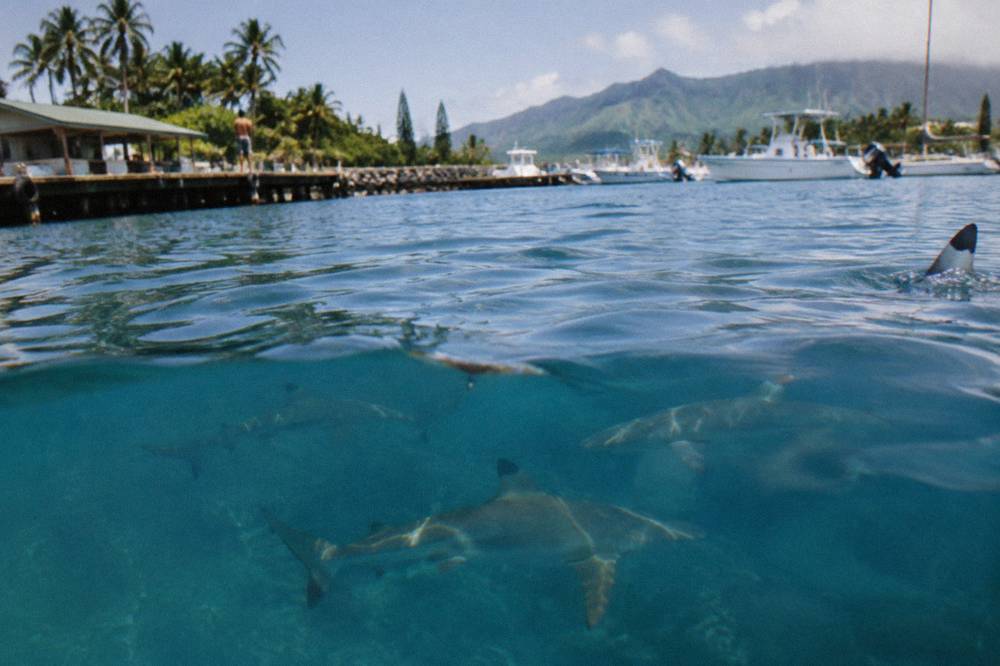
Galapagos sharks and sandbar sharks, reliably, with tiger sharks as the occasional seasonal bonus. Reviews from the 2026 season describe groups of seven to twenty Galapagos sharks at a time, often eight to twelve feet long, gliding within inches of the cage or the swimmers. Operators and the diver community report tiger sharks more often from August through November. Oceanic whitetips, when they appear at all, are a surprise even to the crew.
The species mix is not a marketing line, it is a function of the site. Three miles off Haleiwa the bottom drops away to hundreds of feet, and the sharks that live there are the ones you meet. Galapagos sharks are curious, confident animals that approach the cage or the swim line deliberately, sometimes close enough that guests describe counting the fins. Sandbar sharks tend to cruise a little deeper and a little wider. Neither species charges or attacks the cage; the documented behavior is investigative, circling and passing, which is why the cage-free format exists at all.
Tiger sharks are the wildcard. They are the species most people actually picture when they imagine a Hawaii shark dive, and they do show up at the North Shore sites, but with strong seasonality rather than daily reliability. The 2026 Frontiers in Marine Science analysis of long-term sighting data from the North Shore ecotourism sites found peak daily tiger sightings in October, a period some divers call Sharktober, linked to the movement of mature females into the area. If a tiger shark is your target rather than a whitetip, late summer into fall is the window, and even then no operator guarantees the species on any given day.
For a fuller species-by-species breakdown, the guide to what sharks you will see off Oahu's North Shore covers the roster in detail, including the conservation status of each species. The short table below is the honest version of what a week of tours looks like.
| Species | How often seen on North Shore tours | Typical size | Behavior around swimmers |
|---|---|---|---|
| Galapagos shark | Almost every trip | 8-12 ft | Curious, close passes, calm circling |
| Sandbar shark | Most trips | 5-8 ft | Cruises deeper and wider than Galapagos |
| Tiger shark | Occasional, more likely August-November | 10-14 ft | Cautious passes, rarely lingers |
| Oceanic whitetip | Rare, unpredictable | 6-10 ft | Open-ocean species, not site faithful |
One species you will not see, and should be told plainly: great white sharks are not part of the commercial North Shore encounter at all. They are rare winter visitors to Hawaiian waters as a whole, and no Oahu tour is built around them. Any listing that implies otherwise is worth walking away from.
How Do Cage-Free Shark Swims Work In Hawaii?
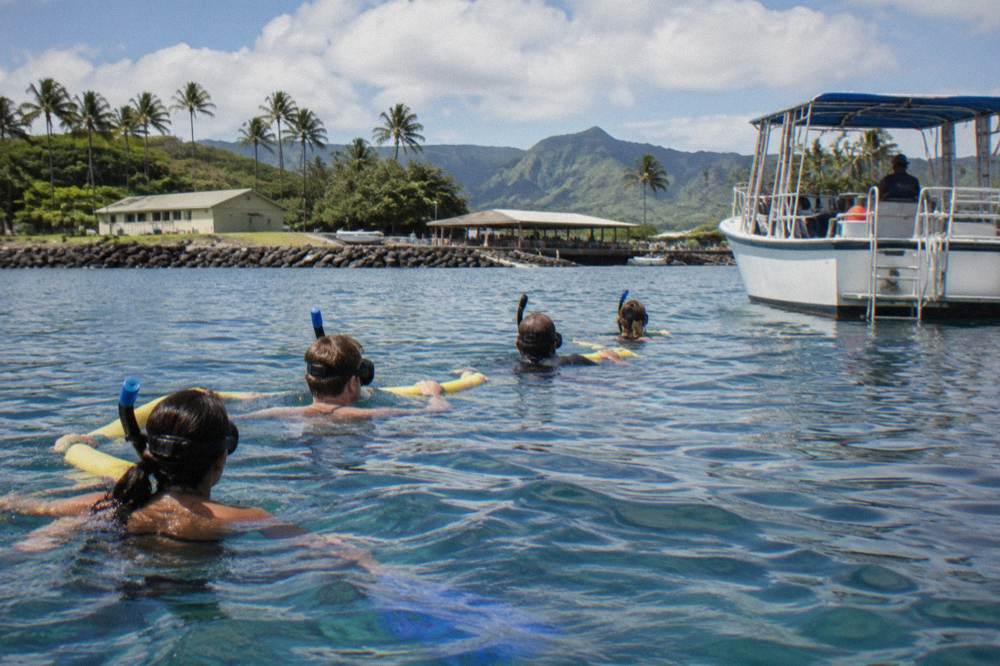
You float on the surface in deep blue water, holding a float line or drifting with the boat, while sharks circle below and around you, with no cage between you. Trips run roughly two hours on the water, three to four miles offshore, in groups small enough that the crew can watch every swimmer. The format is legal, permitted and established, and several operators on this site run it.
The mechanics are simpler than people expect. The boat stops over the deep site, the crew sets a surface line, and guests enter the water in pairs or small groups with a guide. The sharks arrive on their own schedule, drawn by the boat's presence at a site they already know. There is no cage to climb into and no barrier to peer through; the experience is snorkeling, not diving, with sharks passing at arm's length (see Best Cage Experience). Visibility in the calm season is often described as more than 150 feet, which is part of why the format works: you can see the animals coming from a long way off, and so can the crew.
Not every cage-free trip is identical, and the differences matter. One Ocean Diving's swim is guided by marine scientists, which turns the trip into a running biology lesson, and it holds a 4.8 rating from 515 reviews. The company's own program describes years of incident-free operation led by marine biologists, a claim consistent with the broader record: DLNR's public incident log shows no fatalities on Oahu's commercial North Shore shark tours. Ocean Outfitters Hawaii, at 4.8 from 271 reviews, departs from Slip 19 and offers a different logistics setup for the same basic experience.
If you are weighing the cageless option against the classic cage dive, the comparison guide to cage versus cage-free shark diving on Oahu breaks down the trade-offs, and the safety question gets its own honest treatment in is cage-free shark diving in Oahu safe. The one-line version: the cage is a comfort choice, not a survival requirement, and both formats have long commercial track records off Haleiwa.
Is Getting In The Water With Pelagic Sharks Safe?
At the aggregate level, Hawaii's commercial shark tours have a strong record: DLNR's incident log shows no fatalities on Oahu's North Shore commercial shark tours. The same log documents a small number of bites on cageless swims over the years, all classified as provoked incidents tied to the activity itself. Unprovoked incidents statewide run roughly six to ten per year across all ocean users, and tour guests are a small fraction of that.
The word provoked carries specific weight here. In DLNR's classification, a bite that occurs during an activity that places a person deliberately in contact with sharks is counted as provoked, which is separate from the unprovoked incidents that make headlines, like a surfer bitten at a beach. The log documents a handful of provoked bites on swimming-with-sharks tours roughly three miles off Haleiwa over the past several years, with lacerations to arms and hands, and no fatalities anywhere in the commercial tour record. That is the honest picture: not zero risk, but risk of a low and well-documented kind, concentrated in the cageless format where a person and a shark share open water.
The species involved in those incidents were Galapagos and sandbar sharks, the same curious animals that make the tours work. Oceanic whitetips, for what it is worth, have a reputation in the diving world as bold and persistent around anything floating in open water, which is precisely why no responsible operator runs a whitetip swim: the species' behavior around humans in the open ocean is less predictable than the site-faithful North Shore residents. The tours you can actually book are built around animals whose behavior the crews have watched for years.
Practical risk reduction is mostly common sense. Book with permitted operators, which on this site means the licensed roster. Follow the crew's entry and exit instructions exactly, since most incidents across the industry trace to people drifting from the group or touching animals. And if you are prone to motion sickness, read up on handling seasickness on a shark boat tour before you go, because the deep-water sites are three miles of open ocean from land and the surface can move.
Timing shapes both comfort and conditions. The calm season runs roughly May through September, with lighter trade winds, smaller swells and the year's best visibility; winter brings the big North Shore surf that can bump or cancel trips. Water temperatures stay swimmable year-round, from about 75 degrees in the coolest months to 80 or 81 in September. The full breakdown lives in the guide to the best time of year for shark diving on Oahu.
Once the timing question is settled, you can look over the cage-free shark dive with Island View Hawaii and see how the trip details line up with your planned dates.
So, can you swim with oceanic whitetip sharks in Hawaii? Not as a bookable experience, and anyone selling you that is selling hope. What you can do is float in the same deep blue water the whitetips roam, surrounded by Galapagos sharks that are every bit as close, with a crew that knows each animal by sight. For most people who ask the question, that turns out to be the better day anyway.
Common Questions About Swimming With Oceanic Whitetip Sharks In Hawaii
Can You Swim With Oceanic Whitetip Sharks in Hawaii?
No bookable commercial tour in Hawaii offers oceanic whitetip swims. The species lives far offshore in open ocean and does not gather at fixed sites the way North Shore sharks do. Hawaii's shark tours reliably show Galapagos and sandbar sharks, with occasional tiger sharks in late summer and fall.
Are oceanic whitetip sharks dangerous to swim with?
They have a reputation in the diving world for being bold and persistent around anything floating in open water, which is one reason no responsible Hawaii operator runs whitetip encounters. They are classified as Vulnerable by the IUCN and their numbers have declined sharply worldwide, making any encounter both unlikely and best left unengineered.
Where are oceanic whitetip sharks found in Hawaii?
In deep pelagic water far beyond the island shelves, often many miles from land. They appear on DLNR's official list of sharks found in Hawaiian waters, but they are not part of the nearshore community that the Oahu shark tours work with three miles off Haleiwa.
What sharks will I actually see on a Hawaii shark tour?
Galapagos sharks and sandbar sharks on almost every trip, typically in groups of several animals, with tiger sharks appearing more often from August through November. Reviews from the 2026 season describe seven to twenty Galapagos sharks at a time, sometimes passing within inches of the cage or swim line.
Is cage-free shark swimming in Hawaii safe?
DLNR's incident log shows no fatalities on Oahu's commercial North Shore shark tours. The log documents a small number of bites on cageless swims over the years, all classified as provoked. The cage-free format has run commercially for years with permitted operators and trained crews.