Shark Cage Diving On Oahu: What Actually Happens, Step By Step
Most first-timers book a shark cage dive with a vague picture of what the day involves and a dozen unasked questions. This guide walks through the entire experience hour by hour, from the harbor parking lot to the moment you climb back on the boat.
Short answer
A typical Oahu shark cage dive runs about two hours on the water: check-in at Haleiwa Boat Harbor, a 15-minute ride roughly 3 miles offshore into federal waters, 20 to 30 minutes rotating through the cage in small groups, and the ride back. Galapagos and sandbar sharks are the regular visitors, with occasional tiger sharks in late summer and fall.
Most people picture a shark cage dive as one dramatic moment: the cage dropping into churning water while fins circle. The real experience is quieter, more organized, and honestly better planned than that image suggests. A North Shore cage dive is a two-hour boat operation with a crew that has run the same route hundreds of times, in water where the sharks show up on their own schedule. Knowing the sequence, check-in to boat ride to cage rotation, removes almost all of the pre-booking anxiety, because the uncertainty is usually about logistics rather than the sharks themselves.
The practical next step is confirming the departure point and check-in details, which the North Shore shark cage tour listing lays out alongside what the crew provides on board.
This walkthrough follows the standard structure used by the operators running out of Haleiwa Boat Harbor, where every commercial shark cage dive on Oahu departs. Times and details vary slightly between operators, but the bones of the day are the same whether you book the flagship steel-cage trip or a smaller outfit.
What Happens From Check-In To Your Turn In The Cage?
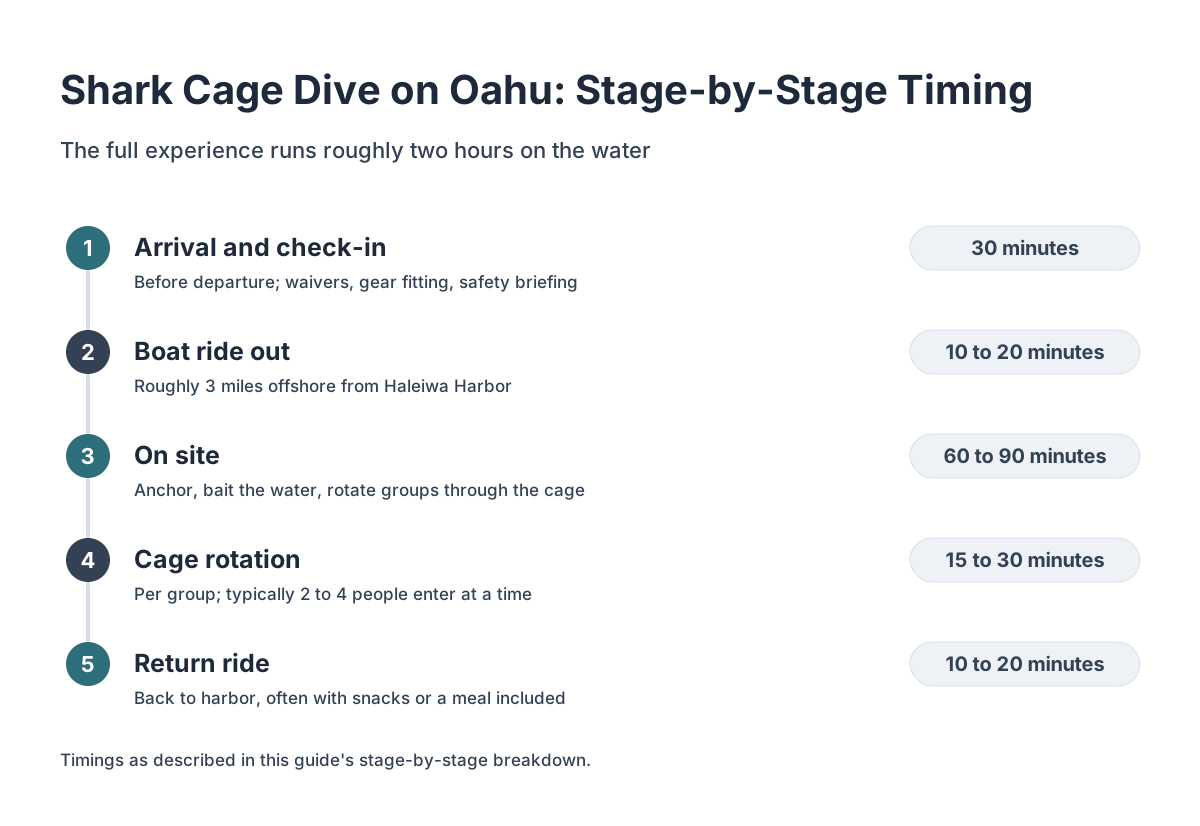
The full experience runs roughly two hours on the water, built from five stages: harbor check-in and a safety briefing, the boat ride about 3 miles offshore, anchoring at the site, rotating through the cage in small groups, and the return to harbor. You are in the cage itself for part of a rotation, not the whole trip, and the crew manages every transition.
Here is the shape of a standard morning, which is when nearly all trips run because the wind picks up in the afternoon:
| Stage | Typical timing | What you are doing |
|---|---|---|
| Arrival and check-in | 30 minutes before departure | Sign waivers, get fitted for mask and fins, safety briefing |
| Boat ride out | 10 to 20 minutes | Ride from Haleiwa Harbor roughly 3 miles offshore |
| On site | 60 to 90 minutes | Anchor, bait the water, rotate groups through the cage |
| Cage rotation | 15 to 30 minutes per group | Enter cage from the boat, view sharks at the surface |
| Return ride | 10 to 20 minutes | Back to harbor; food is on your own unless the listing says otherwise |
Two things surprise people. First, the cage floats at the surface rather than sinking, so you are snorkeling at the top of the water, not descending. Second, the sharks are already there or arrive within minutes, because the operators work a site where Galapagos and sandbar sharks naturally aggregate in deep blue water, often with visibility of 150 feet or more.
If you are still weighing whether the day is worth the drive, the is shark diving in Oahu worth it breakdown covers the value question directly, and the what to wear shark cage diving guide handles the clothing decisions before you ever reach the dock.
What Does Check-In At Haleiwa Boat Harbor Look Like?
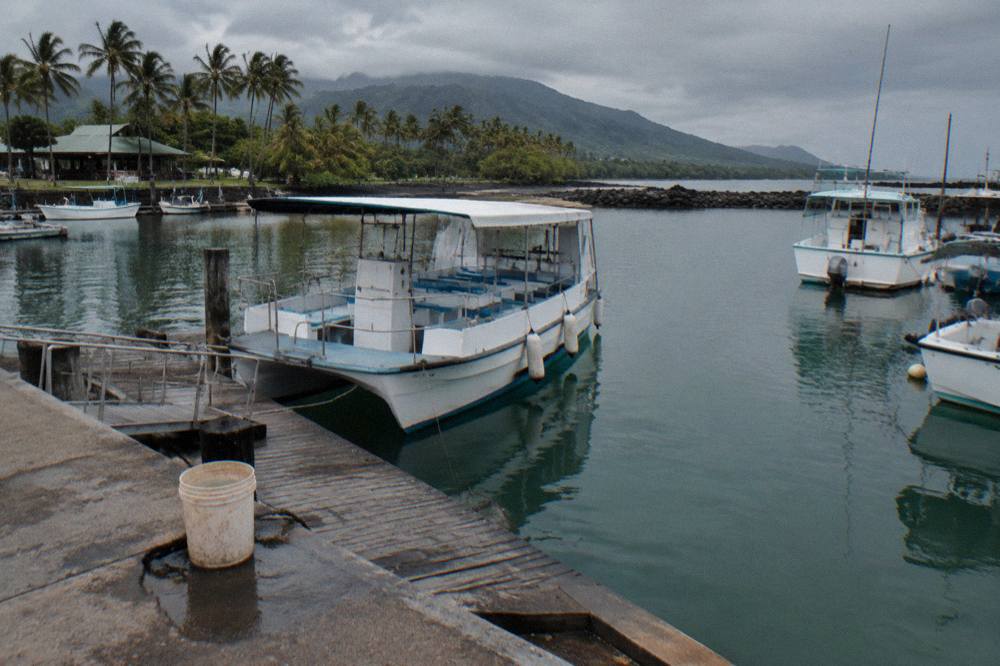
Check-in happens at Haleiwa Boat Harbor at 66-105 Haleiwa Road, about 45 to 75 minutes by car from Waikiki depending on traffic, and you should plan to arrive 30 minutes before departure. Parking at the harbor is free and ample, with public restrooms on site, and the crew runs a waiver signing, gear fitting, and a safety briefing before anyone boards.
The drive is the first real decision of the day. From Waikiki, the route runs H-1 West to H-2 North, then Kamehameha Highway through Wahiawa to Haleiwa, roughly 32 to 35 miles. Google Maps shows a fastest time around 44 minutes with no traffic; a typical mid-morning run is closer to an hour, and rush hours or big-surf days add more because the two-lane sections through Wahiawa slow badly. Morning departures mean you are driving before the worst of it, but leave buffer time anyway.
Once you park, the sequence is simple. You sign a liability waiver, which is standard for any commercial ocean activity in Hawaii. The crew fits you with a mask and snorkel, and often fins, though some operators let you stay in the cage barefoot. Then comes the briefing: where to hold the cage, how to enter without tangling the float line, what the hand signals mean, and where the ladder is if you want out early. Nobody is locked in, and the cage door sits at the surface the entire time.
If you would rather not drive at all, Waikiki to Haleiwa guide explains the transport-included options, and the harbor itself has its own full rundown in the Haleiwa North Shore boat harbor guide.
One operator decision worth making at booking time: Hawaii Shark Encounters meets at Haleiwa Boat Harbor, so you make your own way from Waikiki by car, rideshare, or bus, while Haleiwa Shark Tours meets everyone at Haleiwa Boat Harbor, so you make your own way there by car, rideshare, or bus. rather than a shared shuttle.
What Is The Boat Ride Out To The Dive Site Like?
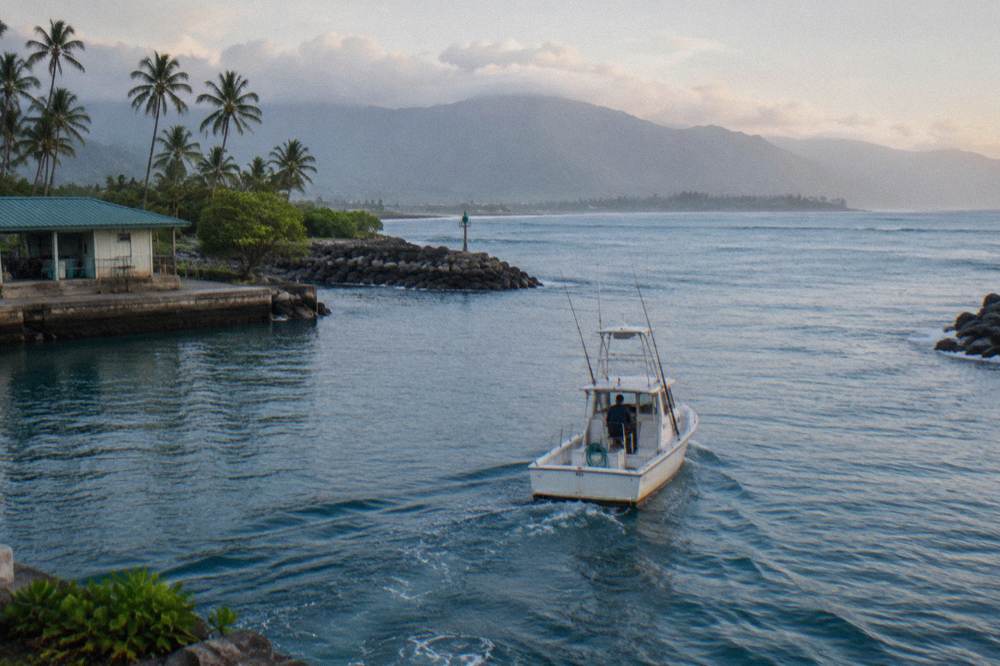
The ride from Haleiwa Harbor to the dive site takes roughly 10 to 20 minutes and covers about 3 miles, ending in deep federal water where the seafloor sits hundreds of feet below. Along the way the crew briefs the group on the species you are likely to see and the rotation order, and the water color shifts from coastal green to open-ocean blue as you leave state waters behind.
The 3-mile distance is not a comfort choice, it is the law. Hawaii statute HRS § 188-40.6 bans shark feeding in state marine waters, which extend 3 nautical miles from shore, so commercial operators run their trips past that boundary into federal waters where the ban does not apply. The operators hold commercial use permits from the state Division of Boating and Ocean Recreation, and the legal framework is spelled out in the official HRS text if you want the primary source.
The ride itself is short but can be bumpy depending on the season. In summer, roughly May through September, the North Shore sits in its calm period with lighter trades and smaller swells, and the run out is usually smooth. In winter, November through April, North Pacific swells can make the trip rougher and push cancellation rates up, which is why the best time of year for shark diving on Oahu matters when you are picking dates. Sea surface temperature off Waimea Bay, the reference buoy for this coast, runs about 80 to 81 degrees in September and dips to roughly 75 to 76 in February and March, comfortable for snorkeling year-round.
Seasickness is the one genuinely common complaint on the ride out, and it is preventable. The seasickness on a shark boat tour guide covers medication timing and boat-side tactics in detail; the short version is to take motion sickness medication the night before and again before boarding, because once you are on the water it is too late for the pills to work.
The flagship North Shore Shark Adventures trip runs this exact itinerary with a steel cage. Its rating sits at 4.8 across 3,241 reviews, the largest review pool of any shark tour on this coast, and the price is listed on the live listing rather than quoted here (see Price Guide). You can check the North Shore Shark Adventures tour page for the full rundown, or go straight to [Check availability](Check availability) on the operator's listing.
How Do You Actually Get Into The Cage?
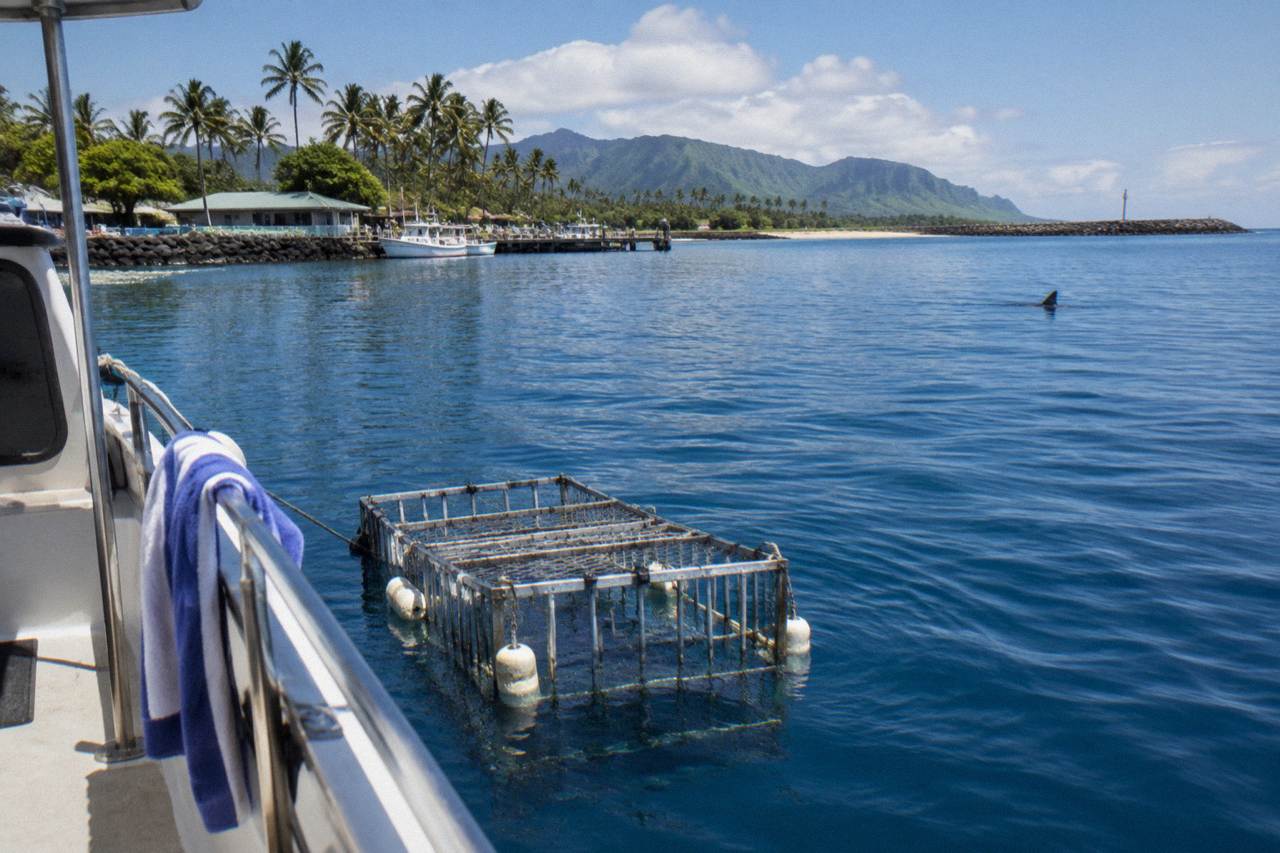
Cage entry happens from the boat, not from the water: you climb down a short ladder or step across a gap into a floating steel or aluminum cage that sits at the surface, holding the bar inside as the crew closes the gate. There is no diving, no descent, and no swimming required, you float at the top of the cage with your face in the water and your hands on the frame.
The moment people fear and the moment as it actually happens are very different. The cage is tethered to the boat, floating upright with its top rim above the waterline. You enter in groups, typically 2 to 4 people at a time depending on the operator and cage size, and the crew counts you in and out. Once inside, you hold the interior rail, put your face in the water, and watch. The wider set of guides lives on Shark Cage Diving Honolulu.
The rotation system is what makes the trip work for a full boat. While one group is in the cage, the others watch from the deck, and the sharks are visible from above the whole time, so nobody on the boat is ever just waiting in the dark. Groups rotate roughly every 15 to 30 minutes, which means even on a fuller trip you get a real stretch of water time plus deck viewing that is often just as good.
What you are looking at, and from how far, is worth knowing in advance:
| Detail | What to expect |
|---|---|
| Cage position | Floating at the surface, tethered beside the boat |
| Entry method | Ladder or step-across from the deck, gate closed behind you |
| Group size in cage | Typically 2 to 4 people per rotation |
| Time in cage | Roughly 15 to 30 minutes per rotation |
| Swimming requirement | None, you hold the rail and float, snorkeling only |
| Sharks' approach | Curious passes close to the cage, often within inches of the bars |
What Happens Once You Are In The Water With The Sharks?
Within the first minute or two in the cage, Galapagos and sandbar sharks typically appear, often several at once, gliding past the bars in calm, investigative passes rather than charging the cage. Reviews routinely describe groups of sharks in the water at once, sometimes inches from the bars, and the experience is closer to being inside an aquarium exhibit than inside an action film.
The species you will almost certainly see are Galapagos sharks and sandbar sharks, typically in the 5 to 15 foot range, with tiger sharks showing up less often and mostly in the late summer and fall window. The state's own species list, maintained by the DLNR Division of Aquatic Resources, confirms all three as resident Hawaiian waters species, and the DLNR shark species list is the authoritative reference. What you will not see is a great white: they are rare winter visitors to Hawaiian waters at most and are not part of the North Shore encounter at all, a premise correction worth making plainly because the phrase "great white cage diving" gets attached to Hawaii searches constantly. The what sharks will you see on Oahu's North Shore guide covers the species picture in full.
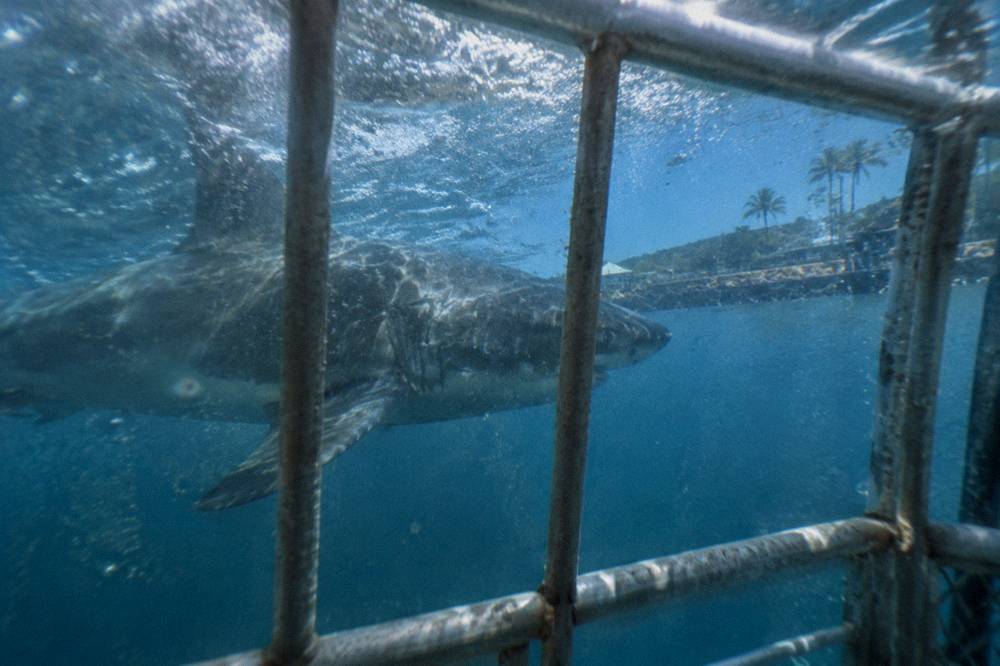
The behavior is the part nobody quite believes in advance. Galapagos sharks approach the cage curiously, turn away at the last moment, and circle back. They do not ram the bars or thrash. A 2026 peer-reviewed BRUV study around Oahu documented 12 elasmobranch species dominated numerically by sandbar sharks, and found Galapagos and sandbar sharks both increase in abundance with depth, which fits what the tours see at a site where the bottom sits hundreds of feet down. The sharks are there because the site sits over deep pelagic water where they naturally aggregate, not because they are being fed inside a tank.
If watching from inside bars feels like too much separation after reading this, the cage-free option exists: Island View Hawaii runs a small-group cageless swim rated 5.0 across 1,179 reviews, where you float at the surface with a guide beside the same sharks. The cage versus cageless shark diving on Oahu comparison lays out the tradeoffs honestly.
For a research-flavored version of the same water time, One Ocean Diving's research trip is guided by marine science staff, guarantees sharks, and carries a 4.9 rating across 587 reviews.
What Happens After You Climb Out Of The Cage?
After your rotation ends, you climb the ladder back onto the deck, rinse off with fresh water if the boat has a shower, and spend the remaining rotations watching the sharks from the rail while other groups take their turn. The ride back is short, and many operators use it for a debrief on shark biology and conservation before you dock at Haleiwa and drive or shuttle back toward town.
The post-dive hour is underrated. From the deck, with the sun up and the water calm, you can watch the full shark group move beneath the surface, which many guests describe as better than the cage view itself because you see the whole animal rather than a passing section. Crews on the science-oriented trips use this stretch to talk about the species, their IUCN status, and the cultural place of sharks in Hawaii, including the shark god Kamohoaliʻi in Hawaiian tradition.
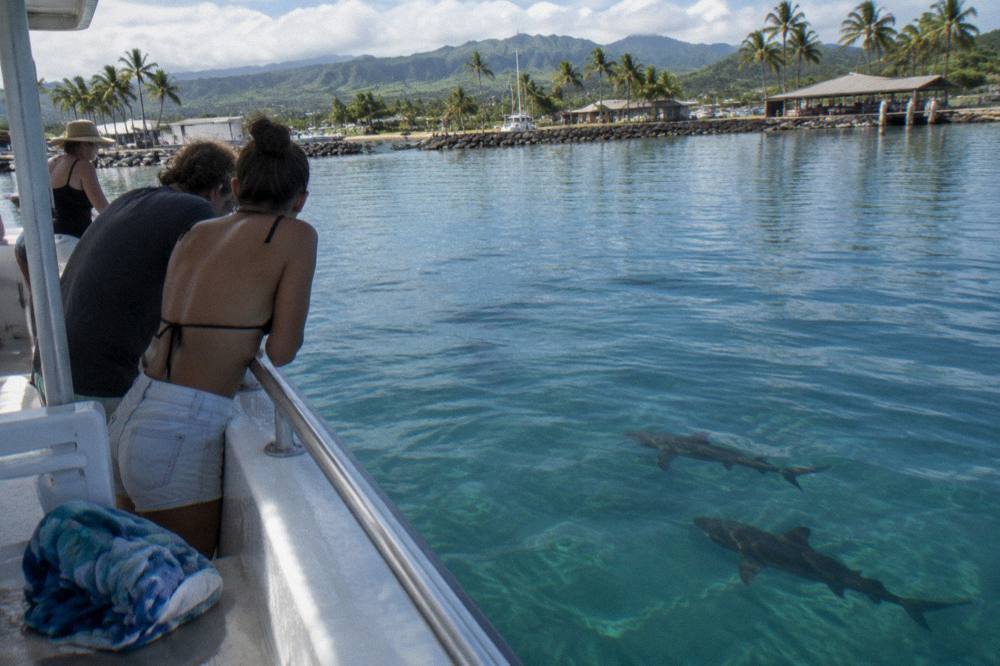
Logistically, plan your day around the return. A morning trip that departs Haleiwa around 7 or 8 AM has you back at the harbor before 10:30, which leaves the whole rest of the day for the North Shore: Haleiwa Beach Park sits beside the harbor with showers and picnic areas, and the town's shave ice and food spots are a short walk or drive away. The free things to do on Oahu's North Shore guide picks up exactly where the boat docks.
If you are traveling with children, note that minimum ages vary by operator, and the shark cage diving kids age requirements guide lists which trips accept which ages before you book a family slot.
Which Oahu Shark Tour Matches This Itinerary Best?
All Oahu cage dives follow the same harbor-to-federal-waters structure, so the real choice is about transport, group size, and extras: the flagship North Shore Shark Adventures steel-cage trip with its 4.8 rating across 3,241 reviews, Hawaii Shark Encounters at 4.8 across 1,556 reviews, or Haleiwa Shark Tours with its smaller groups at 4.9 across 313 reviews.
Here is how the main cage options stack up on the parts of the day this walkthrough covered:
| Tour | Rating and reviews | Transport | Standout feature |
|---|---|---|---|
| North Shore Shark Adventures | 4.8, 3,241 reviews | Self-drive to Haleiwa | Steel cage, about 1.5 hours |
| Hawaii Shark Encounters | 4.8, 1,556 reviews | Self-drive or rideshare | Highest review count in this comparison |
| Haleiwa Shark Tours | 4.9, 313 reviews | Self-drive or rideshare | Smaller groups, flexible schedule |
| One Ocean Diving (research) | 4.9, 587 reviews | Self-drive or rideshare | Scientist-guided, sharks guaranteed |
Prices for every trip on this table are on the live listings rather than quoted here, since they move with season and demand. What is worth deciding in advance is the transport question, because it shapes your whole morning: every tour on this roster is a pre-dawn self-drive, rideshare or bus start from Waikiki.
One departure detail that varies: Ocean Outfitters Hawaii runs its trips from Slip 19 at the harbor and carries a 4.8 rating across 271 reviews, worth knowing if you are already staying on the North Shore and want the shortest possible harbor walk.
Whichever operator you pick, the day itself will look like the one described above: a short drive or shuttle to Haleiwa, a briefing on the dock, a 3-mile run into deep blue water, and a floating cage with curious Galapagos sharks passing close enough to count the fins. The crew has done it hundreds of times. Your job is mostly to show up on time and not skip breakfast.
Common Questions About A Shark Cage Dive On Oahu
How long does a shark cage dive on Oahu take?
Plan on about two hours on the water, plus travel to Haleiwa Boat Harbor. That includes check-in and a safety briefing, a 10 to 20 minute ride roughly 3 miles offshore, 60 to 90 minutes on site with rotating cage groups, and the return to harbor. With the drive from Waikiki, budget half a day for a morning trip.
Do you need to know how to swim or dive?
No. The cage floats at the surface and you hold the rail inside it, snorkeling rather than diving. There is no descent, no tanks, and no swimming between points. If you can float with a mask on, you can do the cage dive.
What sharks will I see in the cage?
Galapagos sharks and sandbar sharks are the consistent visitors, typically 5 to 15 feet long, often several at once. Tiger sharks appear less often and mostly in late summer and fall. Great whites are not part of the North Shore encounter at all.
Is the cage underwater?
No, the cage floats upright at the surface, tethered to the boat, with the top rim above the waterline. You enter from the deck, keep your head above water between looks, and put your face in the water to watch the sharks pass the bars.
What if I get in the cage and want out?
Tell the crew and climb out. The gate sits at the surface the entire time and nobody is locked in. Guests step out early every week, usually for cold or nerves, and the crew counts everyone in and out of the cage on every rotation.
Can I bring a camera into the cage?
Most operators allow a small waterproof camera or a phone in a case, and the visibility makes for striking footage through the bars. The shark cage diving photos and GoPro tips guide covers mounting, settings, and what actually survives salt water.